
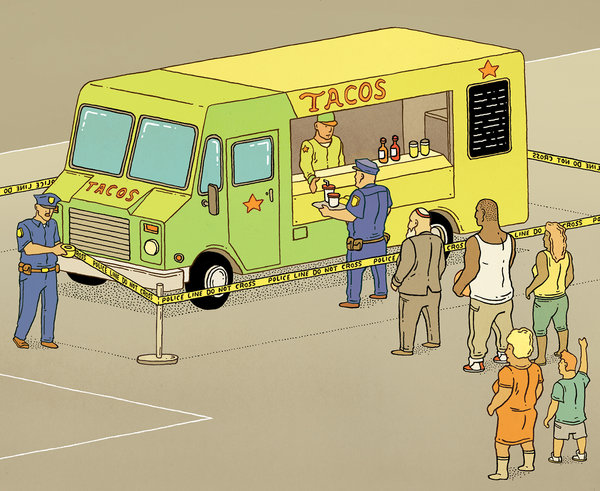
“In the ’80s, the city capped the number of carts and trucks at 3,000. Technically, a permit for a food cart or truck is not transferable, but vendors regularly pay permit holders something like $15,000 to $20,000 to lease their certificates for two years. I was reminded of corrupt countries that I’ve visited, like Iraq and Haiti, where illogical and arbitrarily enforced rules create the wrong set of incentives. Perhaps the biggest winner in our current system is an obscure type of business known as an authorized commissary. By city law, every food cart and truck must visit a licensed commissary each day, where a set of mandated cleaning services can be performed.”

Did you like this?
Tip Freedomwat.ch Staff with Bitcoin
Tip Freedomwat.ch Staff with Bitcoin
Related posts:
Big jump in number of millennials living with parents reported
Jim Rogers: Gold Could Fall To $900, India To Blame For Correction
CIA beat and sodomized wrongly detained German citizen
Swiss bank Wegelin, founded in 1741, to close after US tax evasion fine
US denies China Mobile's capitalism permit citing 'national security'
Barclays fined $44 million over gold price fixing
Restaurant Shift: Sorry, Just Part-Time
Muhammad Film Consultant: 'Sam Bacile' Is Not Israeli, and Not a Real Name
Washington man arrested for online threat against Obama
Woman hoards 30 Government Life line phones or Obama phones
Philadelphia Cop Who Punched Woman On Video Found Not Guilty
The bionic bunch: Gathering of exoskeleton-wearers walk for charity
Massachusetts smokers try to get ahead of new cigarette tax
Special Privilege: Beyonce, Jay-Z Cuba trip was OK'd by US Treasury Dept
Team Trump Walks Back Weak Dollar Talk - For Second Time This Week