
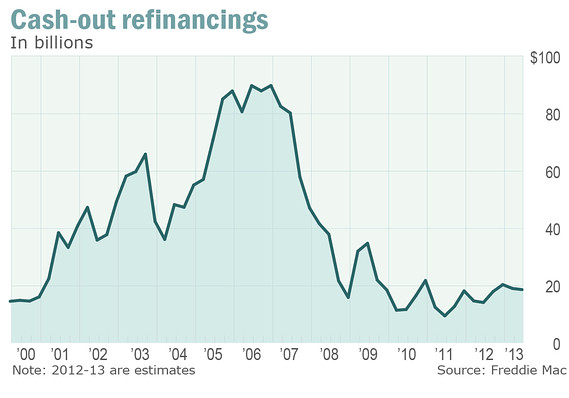
“[The Princeton professors] point out that house-price growth during the last two years was actually a bit better than between 2004 and 2006. But cash-out refinancing volume is way down, as is the building of new units. ‘Dreadful new home sales data yesterday heightened concerns that house-price growth will stall, but we are making a different point: the sensitivity of economic activity to rising house prices is much lower today than it was prior to the Great Recession,’ they say. ‘This is due to a number of factors, such as the rise in investor purchases and the fact that the households who would be most likely to spend out of housing wealth are no longer homeowners.'”

Did you like this?
Tip Freedomwat.ch Staff with Bitcoin
Tip Freedomwat.ch Staff with Bitcoin
Related posts:
S&P: Britain's euroscepticism a major factor in EU's loss of triple-A rating
Takeover Loans Have Few Takers on Wall Street
Boomtown: Washington D.C. Passes Silicon Valley For Highest Median Income In U.S.
Cyprus lifts almost all domestic capital controls
Thriving UK Housing Market Creates 77,894 More 'Millionaires' Last Year
U.S media brings glitz to increasingly urbane Mongolia
Bitcoin Exchange Makes Apparent Move to Play by U.S. Money-Laundering Rules
Germany will resume spying on U.S. for first time since 1945
Power Metals CD launched with exposure to gold, silver, copper
Police Chief Caught On Video Assaulting Shackled Inmate
Japan says any bitcoin regulation should be international
'Anything That Moves': Civilians And The Vietnam War
U.S. Quits UN Human Rights Council Because It’s Not Pro-Israel Enough
Dorner manhunt: LAPD officers opened fire on mother, daughter
Households lost from quantitative easing; gov'ts, big business won [2013]