
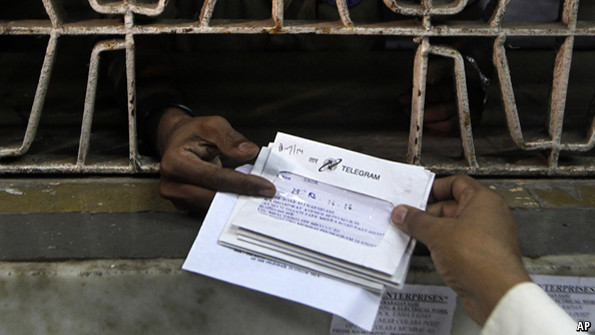
“In India, the telegram held on a bit longer because it was used for internal government communications. The peak year was 1985, when 60m telegrams were sent, according to BSNL. But since then the number has dropped, and the number of telegram offices in India has fallen from 45,000 to just 75. Yet telegrams survive in a few other countries, including Belgium, Japan and Sweden, where former telecoms monopolies maintain them as a nostalgic novelty service. And in many other countries private firms offer telegram-delivery services. So despite several recent reports to the contrary, the telegram is not quite dead, and will probably never die.”
http://www.economist.com/blogs/economist-explains/2013/07/economist-explains-4

Did you like this?
Tip Freedomwat.ch Staff with Bitcoin
Tip Freedomwat.ch Staff with Bitcoin
Related posts:
Swiss Banking: Still Under Attack By Bankrupt Governments
Millions of US government workers hit by data breach
Swiss luxury home market turns downward
Six ways Congress may reform NSA snooping
Private equity crash could trigger next wave of financial crisis, Bank of England warns
Japan stocks and consumer spending storm back on weak yen
Treasury's Lew: Congress Needs to Pass Debt Limit
First U.S. bitcoin ATMs to open soon in Seattle, Austin
Feds seize $27K from couple, give $500 back for "humanitarian purposes"
Switzerland: the world’s gold hub
Hundreds of protesters in Toronto call for Mayor Rob Ford to resign
HealthCare.gov: How political fear was pitted against technical needs
Blackstone Funding Largest U.S. Single-Family Rentals
Army Vet: Police Raided Wrong Apartment, Found No Drugs, Killed His Dog
HSBC Judge Approves $1.9B Drug-Money Laundering Accord [2013]