
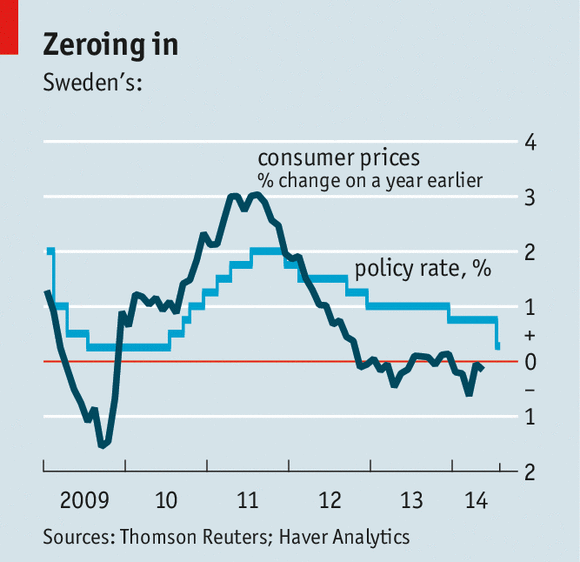
“Sweden’s economy, which it oversees, grew three times faster than the euro zone’s in 2010 and dodged Europe’s double-dip recession in 2012-13. The Riksbank felt confident enough in recovery to start raising interest rates in 2010. The Riksbank worried that rising household borrowing and soaring house prices could lead to trouble down the road. It therefore opted to ‘lean against the wind’, in central bankers’ parlance, and deflate the credit boom before it burst catastrophically. It seems instead to have taken the air out of everything but exuberant markets. Unemployment in Sweden has held steady, while Swedish private-sector debt as a share of GDP is higher now than it was in 2010.”
Did you like this?
Tip Freedomwat.ch Staff with Bitcoin
Tip Freedomwat.ch Staff with Bitcoin
Related posts:
Virginia Democrat mayor invokes WWII internment of Japanese Americans
Citi Economist: Abolish Cash To Enforce Negative Interest Rates
Stratfor emails reveal secret, widespread TrapWire surveillance system
ED officials raided two bitcoin trading firm in Ahmedabad
Soldiers suspected of plotting to kill Obama face death penalty
Marc Faber: 'This is not a very healthy market'
Not All Insurers Game for State Exchanges: The Consumer Impact
‘Chuck Norris’ bridge linking Austria, Slovakia opens
‘Guardian’ editor: Destroying hard drives allowed us to continue NSA coverage
Bitcoin Gets Support From Sberbank CEO as Russia Plans Anti-Terror Law
NSA: Snowden was just doing his job
Liechtenstein for hire at $70,000 a night [2011]
Lead investigator in Oscar Pistorius case is himself facing attempted murder charges
American Citizens: U.S. Border Agents Can Search Your Cellphone
Scientists use 3D printer to make tissue-like material