
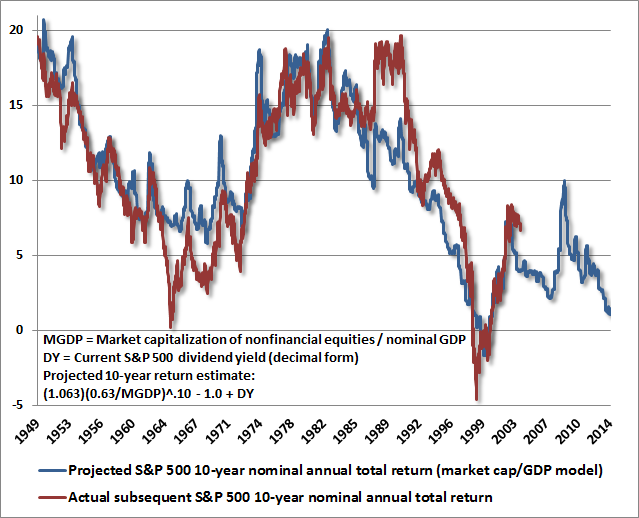
“The fact is that the most reliable valuation measures we identify are generally within just 15-20% of their 2000 extremes, and are already at or beyond levels observed in 1929, 1972, and 2007. Of course, that same advance to extreme overvaluation is also what has raised the total return of the S&P 500 from 2000 until today up to about 3.9% annually. We believe that even that total return is transitory, and presently estimate negative total returns for the S&P 500 on every horizon less than 8 years. We encourage buy-and-hold investors to understand and mentally prepare for the potential depth of interim losses inherent in that strategy (we would presently allow 40-55%).”
http://www.hussmanfunds.com/wmc/wmc140915.htm

Did you like this?
Tip Freedomwat.ch Staff with Bitcoin
Tip Freedomwat.ch Staff with Bitcoin
Related posts:
Can You Pass The Terrorism Quiz? (Updated June 2013)
How to Spot a Market Top
10 investing insights from Street Smarts by Jim Rogers
Bill Bonner: Too Much Of A Good Thing
The Source of Systemic Crisis: Risk and Moral Hazard
Better “Safe Haven” – Switzerland or Canada?
Paul Rosenberg: The Beauty and Dignity of the Productive Class
How to Lose a Constitution—Lessons from Roman History
Why Conservatives Accept High Taxes, the Federal Reserve System, and Fiat Money
By the Numbers: Does Immigration Cause Crime?
Freedom or the Slaughterhouse? The American Police State from A to Z
Mises on the Robotics Revolution
It’s a Sound-Money Alternative to the Dollar
Why Serial Asset Bubbles Are Now The New Normal
The Case for Fed Tapering Sooner Rather Than Later