
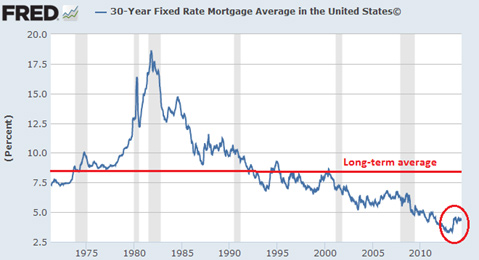
“The refinancing game is nearly over. Just looking at the mortgage side of life, this means that the increase of households’ retained cash flow is unlikely to improve further. For many of the large lenders, it also means a reduction in workforce—a significant one, in many cases—which will impact employment figures and possibly further recovery. A final note in this saga pertains to household leverage. Common wisdom seems to hold that US households have deleveraged since the mid-2000s crash. Unfortunately, that’s not the case. In 2008, total household liabilities stood around $14.2 trillion. At the end of 2013, they were $13.8 trillion—a paltry 2.8% decline.”

Did you like this?
Tip Freedomwat.ch Staff with Bitcoin
Tip Freedomwat.ch Staff with Bitcoin
Related posts:
Anthony Gregory: The Bellicosity of a Democrat’s Second Term
Khan Academy's Challenge to State-Certified Educators
Who Needs an Official State Media When We’ve Got CNN?
Jeffrey Tucker: Is There A Viable Alternative To College?
How to Use Sex Like a Russian Spy
Extremely Serious Privacy Problem in America
Will Grigg: "Damned from Memory": When the Drug War Turns on its Own
Doug Casey on Opting-Out
Canola Oil: Good or Bad?
The Holocaust, the West, and the Lost Caribbean Shelter
Creating a Culture of Denunciation
Should You Invest in the Marijuana Boom?
Bill Bonner: Is It Time To Sell Your Gold?
Doug Casey Refutes Common Hesitations to Internationalize
Criminal Enterprise Operations of the Police