
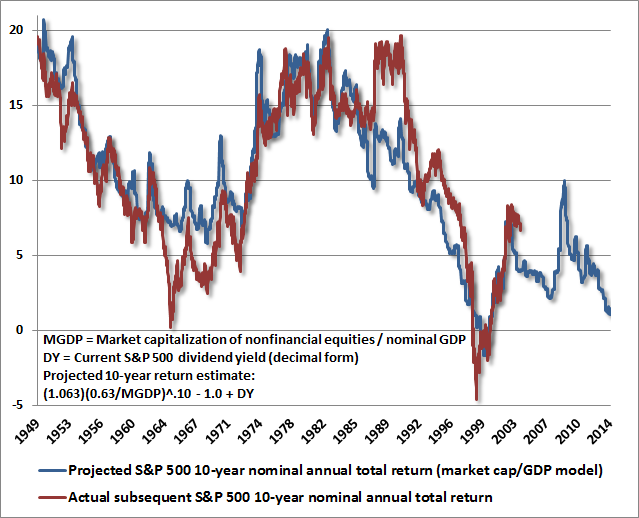
“The fact is that the most reliable valuation measures we identify are generally within just 15-20% of their 2000 extremes, and are already at or beyond levels observed in 1929, 1972, and 2007. Of course, that same advance to extreme overvaluation is also what has raised the total return of the S&P 500 from 2000 until today up to about 3.9% annually. We believe that even that total return is transitory, and presently estimate negative total returns for the S&P 500 on every horizon less than 8 years. We encourage buy-and-hold investors to understand and mentally prepare for the potential depth of interim losses inherent in that strategy (we would presently allow 40-55%).”
http://www.hussmanfunds.com/wmc/wmc140915.htm

Did you like this?
Tip Freedomwat.ch Staff with Bitcoin
Tip Freedomwat.ch Staff with Bitcoin
Related posts:
Got grandparents? Four places where you can become a citizen.
Paul Craig Roberts: How the US Became the USSR
Jacob Hornberger: U.S. Soldiers Died for Empire and Hegemony
Wendy McElroy: Let a Thousand Home Businesses Bloom
Grasping for Dignity in the Era of the American Police State
This Was Mises’s Main Case for Peace
Rulership's Last Stand: Is the Government Out to Eat You?
Fred Reed: The Eye of Sauron
The Pentagon's Bases of Confusion
Robert Wenzel: An Examination of Key Factors in the Collapse of the Soviet Union
Ron Paul: Meaningless Words in Politics
My Question for Simon Johnson
How to Become the British Monarch
The American Hiring Paradigm Is Broken
You’re a Criminal in a Mass Surveillance World – How to Not Get Caught