
“Economist and historian, Deirdre McCloskey, discusses why the explosion of widespread wealth in the west was the result of changes in rhetoric about markets and free enterprise finally became enthusiastic and encouraging of their inherent dignity.”

“Economist and historian, Deirdre McCloskey, discusses why the explosion of widespread wealth in the west was the result of changes in rhetoric about markets and free enterprise finally became enthusiastic and encouraging of their inherent dignity.”
“What’s going to happen to the stock market in the near term? The market is likely to continue rising until ‘something’ gives, either higher interest rates or lower corporate profits. That ‘something’ may be unknown but it will be a negative event, whatever it turns out to be. So, risk is high and warning signs are flashing: 1. Stock trading volume is ‘dead.’ Almost nobody is buying and sellers have their hands on the sell button but waiting for a trigger. 2. The largest buyers of stocks are the corporations themselves, which have a notoriously bad record of buying at market tops. The smart money (hedge funds, corporate insiders, and institutional investors) are currently net sellers. […]”
http://www.investingdaily.com/20998/why-small-caps-make-sense-for-retirees/
“The huge declines in U.S. stocks in recent months have revived interest in a BusinessWeek cover story from August 1979 entitled ‘The Death of Equities.’ At the time the story was written, the stock market had sustained serious losses and the long-term health of the U.S. economy was a significant concern. Few, if any, market forecasters were willing to call a recovery at the time, and the story provides a telling look at how inflation had ravaged the market landscape—and investor psychology—at the close of the 1970s. So step back in time with us and read BW’s take on the state of the market in August 1979.”

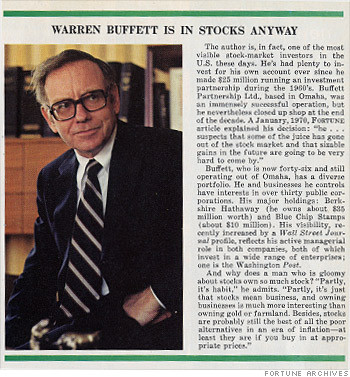
“Every Sunday, Fortune publishes a favorite story from our archive. As controversy swirls around whether Fed Chair Ben Bernanke is downplaying inflation predictions, we turn back to May 1977 for timely advice from Warren Buffett. The Oracle of Omaha has clashed with Bernanke over inflation time and time again, and here Buffett warns how rising prices can hamper growth ‘not because the market falls, but in spite of the fact that the market rises.'”

“Two years ago, a blogger named Jonathan Corbett published a YouTube video that seemed to show a facepalm-worthy vulnerability in the TSA’s Rapiscan full-body X-ray scanners. The TSA dismissed Corbett’s findings, and even called reporters to caution them not to cover his video. Now a team of security researchers from the University of California at San Diego, the University of Michigan, and Johns Hopkins plans to reveal their own results from months of testing that same model of scanner. And not only did they find that Corbett’s weapon-hiding tactic worked; they also found that they could pull off a disturbing list of other possible tricks.”


“Finding a home in a place where house prices are rising is a problem shared by many around the world. In the Egyptian capital, Cairo, rising prices have forced almost two million people out of their homes over the years. What is unique in this city, though, is that many now live in cemeteries. The problem has existed for about 50 years and its one that the government is struggling to get to grips with.”

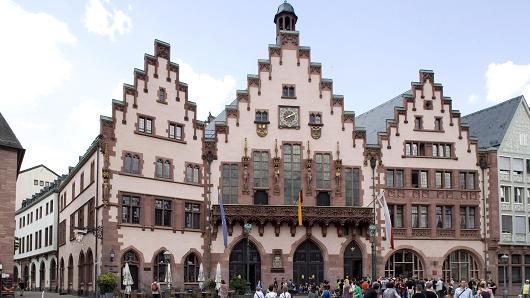
“Major cities like Frankfurt, the financial capital, Munich with its famous beer gardens and proximity to the Alps and Stuttgart, the home of Mercedes and Porsche, are becoming increasingly attractive as a place to live and work. Germans from rural settings and immigrants are flocking to the cities. But like in London, an equally potent driver of the property market in Germany is the good old ‘search for yield’. Contrary to the U.K. though, it’s not Germany’s capital that is seeing the highest prices. According to research from B+D, the most expensive properties in Germany are found in Munich (an average 4,800 euros ($6,427) per square meter).”

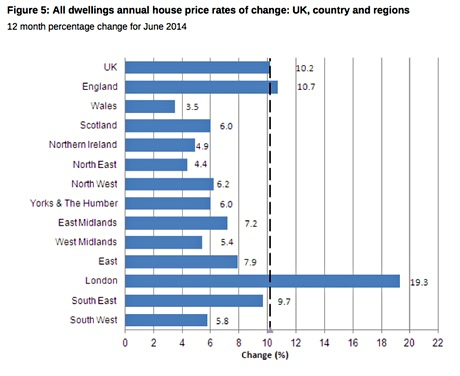
“The Office for National Statistics data showed the annual growth rate had fallen from 10.4% in May, but prices rose by 0.5% on the month to a record £265,000 for the average property. The amount paid by first-time buyers was 12% higher than in June 2013, at an average of £204,000 – the biggest rise since 2010. Although recent figures from the Council of Mortgage Lenders suggest first-time buyers have been re-entering the market, campaign groups warned that homes were getting further out of reach for those forced to rent.”
http://www.theguardian.com/money/2014/aug/19/uk-house-prices-record-high

“Italy saw borrowing costs fall to the lowest levels on record at an auction of five-and-ten-year government bonds on Wednesday, as investors continued to gauge the health of the euro zone’s third-largest economy. Italy’s Treasury sold €2.5 billion worth of ten-year debt at an average yield of 2.6%, down from 2.81% at a similar auction last month. Rome also sold €3 billion of five-year debt at an average yield of 1.2%, compared to a yield of 1.35% in June.”