“Instead of over-the-top responses by weak leaders, such as George W. Bush or Francois Hollande, we need strong and effective leaders to withstand the pressure for excessive and thus counterproductive responses—exactly what the terrorists want. After 9/11, the United States has needlessly attacked or invaded at least seven Muslim countries and only made the terrorism problem worse. Presidents Bush and Obama have told the world that these military actions are not a ‘war on Islam’; unfortunately, to those at the other end of the gun barrel, it doesn’t look that way.”
“Following the steep but relatively contained market plunge in August, the major indices rebounded toward their May highs, but neither the broad market nor high-yield credit participated meaningfully. Only 34% of individual stocks remain above their respective 200-day averages, widening credit spreads suggest growing concerns about low-quality debt defaults, and sectoral divergences (e.g. relative weakness in shipping vs. production) confirm what we observe in leading economic data — a buildup of inventories and a shortfall in new orders and order backlogs.”
“Today’s horrific attacks in Paris have moved us all, and the more we learn, the more our hearts ache,” said Governor Cuomo. “These were cowardly acts of evil by people who have inexplicably chosen to believe in radical hatred above all else.”
‘Inexplicable’; perhaps, for the pathologically dense.
Let France and all nations following its path know that they will continue to be at the top of the target list for the Islamic State and that the scent of death will not leave their nostrils as long as they partake in the crusader campaign, as long as they dare to curse our Prophet (blessings and peace be upon him), and as long as they boast about their war against Islam in France and their strikes against Muslims in the lands of the Caliphate with their jets, which were of no avail to them in the filthy streets and alleys of Paris. Indeed, this is just the beginning. It is also a warning for any who wish to take heed.
France? That effete land of art, fashion, and cheese?
It’s not as if they should be surprised. After all, if the Paris bombings were a reaction motivated by French foreign military adventures, we have seen this before. From the article:
This isn’t the first time France’s involvement abroad has led to terrorism at home. In 1995, Algerian Islamists set off eight bombing attacks that killed eight people and wounded 200 in Paris to punish France for supporting the government in that country’s civil war.
There is, however, said to be no specific intelligence indicating there is a direct terrorist threat to attack Britain. The heightened measures in the UK are partly to reassure the public [..]
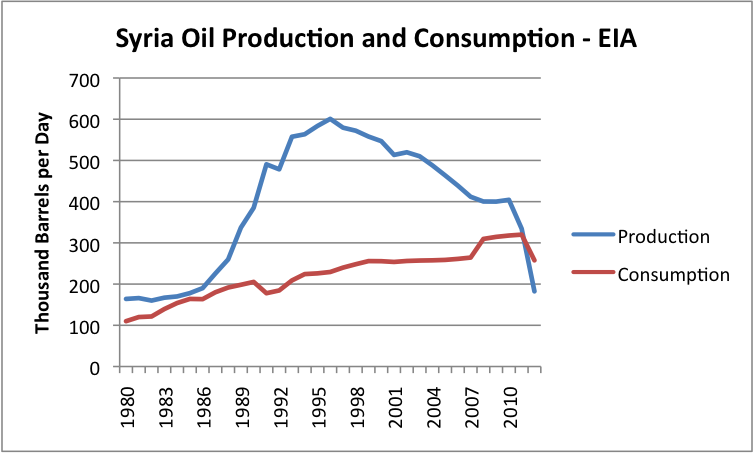
Knowing Syria was a critical piece in its energy strategy, Turkey attempted to persuade Syrian President Bashar Assad to reform this Iranian pipeline and to work with the proposed Qatar-Turkey pipeline, which would ultimately satisfy Turkey and the Gulf Arab nations’ quest for dominance over gas supplies, who are the United State’s allies. But after Assad refused Turkey’s proposal, Turkey and its allies became the major architects of Syria’s “civil war.”
Mainstream media outlets repeat the comfortable myth that terrorist attacks are primarily motivated by the desire to impose Sharia law in Western countries. While the precise mechanism by which random acts of violence lead to a formal Sharia law regime is yet to be identified, it is perhaps more instructive to examine the statements made by the attackers themselves, which invariably cite not only their religious beliefs, but specific acts of military violence carried out by U.S., NATO, and/or GCC partners in Middle Eastern countries. Two recent examples are the statements following the Charlie Hebdo and November Paris attacks.
But let’s step back to the bigger picture for a moment:
It is not hard to imagine that every one of these attacks that senselessly kills children, friends, and loved ones creates motivation to retaliate among those remaining. ISIS recruiters offer a vision of utopia to a generation of young people that has only known war, poverty, and personal tragedy.
Explaining the inexplicable: How can terrorists be gaining ground versus the most powerful governments in the world?
In Iraq, then Libya, then Egypt, former U.S.-backed authoritarians heading secular governments were deposed one by one. Saddam Hussein and Muammar Gaddafi were victims of openly executed military regime change operations, while Hosni Mubarak was the victim of a series of events that led to the present U.S.-backed military dictatorship. The latter was accomplished through an alphabet soup list of NGOs:
Washington’s democracy assistance programme for the Middle East is filtered through a pyramid of agencies within the State Department. Hundreds of millions of taxpayer dollars is channeled through the Bureau for Democracy, Human Rights and Labor (DRL), The Middle East Partnership Initiative (MEPI), USAID, as well as the Washington-based,quasi-governmental organisation the National Endowment for Democracy (NED).
In turn, those groups re-route money to other organisations such as the International Republican Institute, the National Democratic Institute (NDI), and Freedom House, among others. Federal documents show these groups have sent funds to certain organisations in Egypt, mostly run by senior members of anti-Morsi political parties who double as NGO activists.
The Middle East Partnership Initiative – launched by the George W Bush administration in 2002 in a bid to influence politics in the Middle East in the wake of the September 11 terrorist attacks – has spent close to $900m on democracy projects across the region, a federal grants database shows.
USAID manages about $1.4bn annually in the Middle East, with nearly $390m designated for democracy promotion, according to the Washington-based Project on Middle East Democracy (POMED).
The US government doesn’t issue figures on democracy spending per country, but Stephen McInerney, POMED’s executive director, estimated that Washington spent some $65m in 2011 and $25m in 2012. He said he expects a similar amount paid out this year.
A main conduit for channeling the State Department’s democracy funds to Egypt has been the National Endowment for Democracy. Federal documents show NED, which in 2011 was authorised an annual budget of $118m by Congress, funneled at least $120,000 over several years to an exiled Egyptian police officer who has for years incited violence in his native country.
This appears to be in direct contradiction to its Congressional mandate, which clearly states NED is to engage only in “peaceful” political change overseas.
We know where the military dictatorship gets its money and weapons. Where do terrorists get the money and weapons with which they can become an organized army, occupy territory, and train recruits?
The source of motivation for terrorist attacks is apparently not “inexplicable”. The means by which those attacks are carried out also does not seem to be at all “inexplicable”.
What may be the truly “inexplicable” and uncanny part of the process: the ability of Western governments and media to cultivate such mass ignorance that they are able to pretend to be mere victims of purportedly “inexplicable” attacks, thus enabling ever-ongoing seizures of extra-constitutional police and emergency powers that are unlikely to be relinquished voluntarily.
The Reichstag Fire in Nazi Germany was perhaps the template for this mechanism of permanent ’emergency’ escalations of state power, which has today evolved into a global phenomenon, fueled by ISIS and at the same time fueling ISIS through its reactions.
One could ascribe failures to stop future attacks on power elite ‘interests’ or on civilians to malice, or to incompetence instead, depending on your perspective.
What’s the answer?
Interpret the latest attack as another datapoint indicating failure of the policy, and reverse course. Withdraw from foreign military occupations, renounce illegal emergency powers and secret spying on citizens, convert payments to foreign militaries and governments into aid for war victims including resettlement domestically, and sweep away the hubristic ruling class ideology that enabled this global human rights catastrophe and policy disaster in the first place.
Which course will the U.S. and NATO governments pursue from here? Perhaps a course they could have chosen almost 10 years ago that would certainly not have trained and armed ‘friendly’ terrorists, would certainly have not motivated young people to join terrorist organizations with more anger-inducing tragedies, and would certainly not have deliberately destabilized an entire region of the globe through armchair regime change pursuits.
Only a madman would repeat the same courses of action and expect differing results. So are Western leaders mad, or are they openly pursuing the same results?
Did you like this? Tip Freedomwat.ch Staff with Bitcoin
“The only reason they’ve been able to get away with the scam for so long is that there isn’t much of a threat of terrorism to defend against. Even with all these actual and potential failures, there have been no successful terrorist attacks against airplanes since 9/11. If there were lots of terrorists just waiting for us to let our guard down to destroy American planes, we would have seen attacks — attempted or successful — after all these years of screening failures. No one has hijacked a plane with a knife or a gun since 9/11. Not a single plane has blown up due to terrorism.”
“Apathy wasn’t the problem. During a war that pitted the free world against the forces of fascism, nationalism, and racism, the liberal democracies actively pursued illiberal policies at home and sabotaged their citizens’ efforts to save thousands of families from extermination. As Perl bluntly puts it, ‘The Nazis set the house aflame, and the free world barred the doors.’ In a different version of history, one in which compassion and local autonomy had triumphed, a Caribbean haven would have allowed tens, maybe hundreds of thousands of human beings to be alive today, whose parents and grandparents were, in our actual history, lost to Hitler’s Final Solution.”
“Investors who refused to take the speculative bait may have been the first casualties of the Fed’s policies. But now, it is investors who remain fully invested in obscenely overvalued equities and junk credit that have become the unwitting dupes in this game. If the Fed cannot force people to abandon saving behavior with zero interest rates, some members of the FOMC have openly talked about driving interest rates to negative rates to ‘stimulate’ spending. This is not economics, it is megalomaniacal sociopathy. Centuries of economic history warn that this speculative episode, too, will end in a collapse.”
“The creation of the Federal Reserve System in 1913 was the re-establishment of the oligarchs’ lender of last resort. That meant that the federal debt would become the foundation of the entire economy: debt purchased by the central bank to balloon the monetary base. To pay off the debt would create mass deflation and depression. The oligarchs now have immunity. Congress will not order an independent audit of the FED. The model is the Bank of England. It has been the chief insurance agency of the Anglo-American oligarchy ever since 1694. The ‘Glorious Revolution’ of 1688/89 was in fact the symbolic triumph of the oligarchs over the king.”
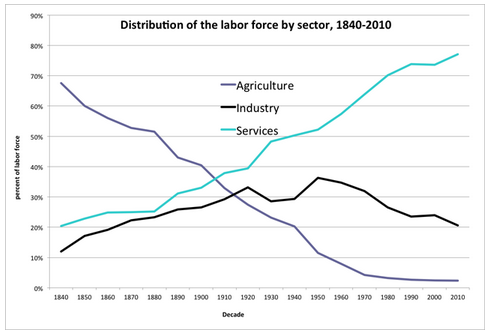
“Manufacturing is going the way of agriculture. But we are not getting poorer. This has been true since at least 1840. Free trade in manufactured goods is of marginal overall importance. Free trade in digital services will increase. The government cannot easily tax this kind of international trade. There are no tariffs and quotas on information. But protectionists never mention this aspect of free trade. They are focused on physical production, which is of declining value in our lives. The decline in American manufacturing is not the result of free trade. It is the result of our increasing wealth. We buy services and digits, not space-occupying stuff.”
Sam Zell, who called the top of the property bubble in 2007 by selling $23 billion worth of office properties to Blackstone, just sold 23,000 apartment units to Starwood for $5.4 billion.
Commercial real estate prices are now 14.5% above their 2007 highs. Cap rates are at record lows, breaking the previous all time record low set in 2007.
Consumer price inflation will arrive as a result of rising wages making consumer borrowers more creditworthy, combined with the Fed reducing the 0.25% rate of interest on excess reserves that it has paid since 2008. As of yet, commercial banks can collect these payments as zero-risk corporate welfare in exchange for keeping $2.5 trillion in assets against which they could lend out of service.
“Today’s televisions are far superior to the ones shown in the film. Video calling is cheaper and easier than predicted, with apps like Skype and FaceTime. Virtual reality is not yet mainstream, but it may soon be, and we already have plenty of wearable tech such as Google Glass. We don’t have fax machines in every room because we have a far cheaper, easier and more environmentally friendly alternative in email. Nobody can predict the future, not even sci-fi screenwriters who are paid lots of money to try. [..] Entrepreneurs respond to our wants and needs today, but they also tap into our latent demands — creating amazing new stuff we didn’t even know we wanted.”