
“Michigan’s Senate unanimously passed legislation to protect its citizens – and, we’ll presume, any American refugee who flees to the Mitten State – from Obummer’s ‘legalized’ kidnapping and ‘indefinite detention,’ a.k.a., the NDAA. ‘No member of the Michigan national guard on active state service shall aid an agency of the armed forces of the United States in any investigation, prosecution, or detention of any person pursuant to section 1021 of the national defense authorization act for fiscal year 2012.’ Obummer’s grab for such dictatorial power has suffered a slew of defeats lately in Montana, Indiana, Colorado and Arizona.”
Tag Archives: Laboratories Of Democracy
Four States Advance Legislation To Block NDAA Indefinite Detention
“In a stunning move last week, four states, Indiana, Colorado, Montana and Arizona, successfully advanced anti-NDAA legislation. The goal for each bill is to protect the people of that state from indefinite detention under the National Defense Authorization Act (NDAA) for Fiscal Year 2012. The 2012 NDAA applies broad detention power to U.S. soil, allowing the federal government to detain and even execute any person, including an American citizen, on U.S. soil. There has not been such backlash against a federal law since Congress attempted to enforce a mandatory national speed limit, as over 21 states have introduced legislation to counter the law.”
Montana House Votes 97-1 to approve anti-NDAA bill

“In a huge win for the Bill of Rights, the Montana House of Representatives overwhelmingly approved a bill to ban indefinite detention in Montana by a vote of 97 to 1. Introduced by state Rep. Nicholas Schwaderer, HB 522 would also ‘prohibit state cooperation with federal officials’ who try to enforce the National Defense Authorization Act (NDAA). The lone no vote was cast by Democrat Bob Mehlhoff. HB 522 previously passed the House Judiciary Committeeunanimously. The bill now heads to the state senate for approval.”
Always a One-Way Street–Er, Flight
“Kansas is treading ground Texas did in 2011, with 21 members of its legislature introducing a bill that would prohibit the TSA’s sexual assault at airports. And ‘experts’ once again predict problems arising from such courage, chief among them that ‘the U.S. Constitution bars states from regulating the actions of the federal government.’ Why do we never hear a peep from these ‘experts’ about the Fourth Amendment’s ban of unreasonable search and seizure?”
Drones patrolling U.S. borders spark controversy over privacy

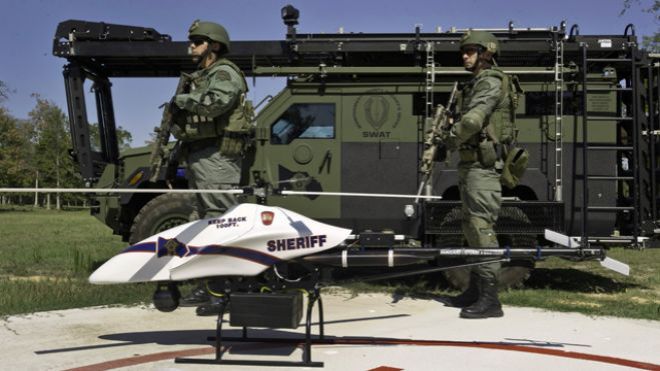
“Intended to protect the borders from illegal crossings and the import of illegal drugs, ten drones flown by U.S. Customs and Border Protection have also sparked a controversy over privacy. The plane are piloted remotely and their images are reviewed in real time by agents at Fort Huachuca in Sierra Vista, Arizona. The data is used to help direct agents on the ground or in a helicopter to make a bust. ‘The fact we can turn the lights off, we are almost stealth,’ said director of Air Operations Dave Gasho. And that, critics say, that is the problem.”
States step up fight against use of surveillance drones by law enforcement

“Lawmakers in at least 11 states are proposing various restrictions on the use of drones over their skies amid concerns the unmanned aerial vehicles could be exploited by local authorities to spy on Americans. Virginia lawmakers on Tuesday approved a two-year moratorium on the use of drones by police and government agencies. Proponents of the legislation say the unfettered use of drones could infringe on Virginians’ privacy rights. In an attempt to address police concerns, legislators carved out exceptions for the use of drones in emergencies, or to search for missing children or seniors.”
http://www.foxnews.com/politics/2013/02/06/states-propose-limiting-use-drones-by-police/
Texas Proposal Would Make Local Police Enforcement Of Federal Gun Laws A Crime

“Police officers could be charged with a crime for enforcing new federal gun control laws in Texas under a proposal by a lawmaker who acknowledges the measure likely would end up in the U.S. Supreme Court. Rep. Steve Toth, a newly elected Republican from the Woodlands, said his proposal would prevent officers from carrying out any future federal orders to confiscate assault rifles and ammunition magazines.”
Illegal Drugs: The great experiment

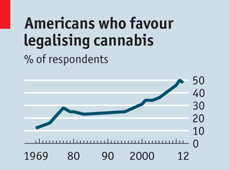
“Decriminalising consumption does nothing to break the grip of gangsters over the drug business. For that to happen, production and distribution also need to be legalised. That is why the experiment under way in the United States is so important. Colorado and Washington now have the chance to create a legal but regulated market in marijuana, similar to those for tobacco or alcohol. One immediate consequence is that the United States will be in breach of the UN Convention. Good. It should now join Latin American governments in an effort to reform that outdated document to allow signatories room to experiment. Imposing a failed policy on everybody benefits nobody.”
Doors swing open for advocates of marijuana legalization on Capitol Hill
“Advocates for the legalization of marijuana plan to step up their political giving and lobbying efforts now that members of Congress are taking an interest in changing federal drug laws. The lobbyists say lawmakers who wouldn’t give them the time of day are suddenly interested in meeting with them and introducing legislation following the approval of ballot initiatives in Colorado and Washington that legalized recreational use of the drug. Lobbyists say the battle that is brewing over drug laws will be far-reaching and not confined to recreational use of marijuana.”
Arizona bill would make gold, silver coins acceptable forms of payment
“Arizonans who fear the federal government will make their folding money worthless may soon be able to substitute privately minted gold and silver coins. The measure is crafted to get around a provision of the U.S. Constitution which bars states from minting their own coins. But supporters also note it says that states cannot ‘make any thing but gold and silver coin a tender in payment of debts.’ That, they contend, permits states to recognize coins minted by others. Crandell said the ultimate bottom line is a lack of confidence in the dollar — or at least the real value of the dollar, what with the Federal Reserve Bank continuing to print new money.”