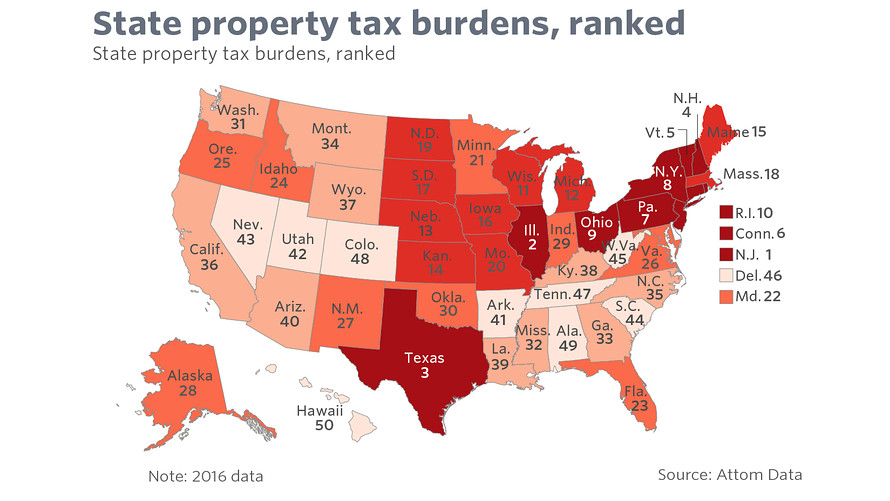
Want to see how America is changing? Property taxes hold the answer

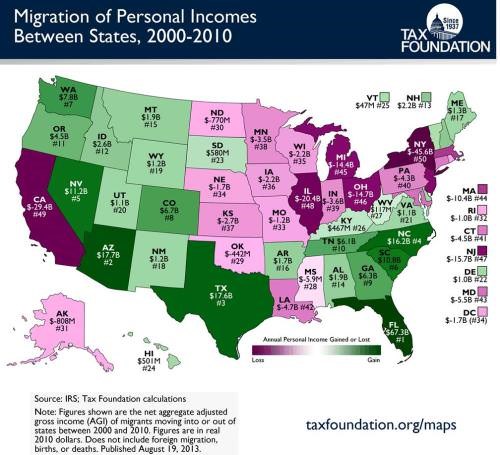
“In 2016, United Van Lines reported, New Jersey was the state with the most ‘outbound’ movers, followed by Illinois, New York and Connecticut. The top ten ‘inbound states’ included some with a higher tax burden, like #5 Vermont, but also Nevada and South Carolina, which rank #43 and #44, respectively.”

Read more: http://www.marketwatch.com/story/want-to-see-how-america-is-changing-property-taxes-hold-the-answer-2017-04-07

Scan to Donate Bitcoin to Freedomwat.ch Staff
Did you like this?
Tip Freedomwat.ch Staff with Bitcoin

IRS Seized $17 Million From Innocent Business Owners Using Asset Forfeiture

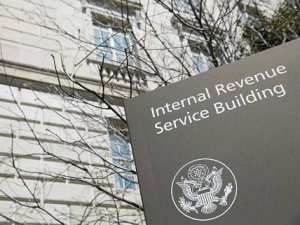
“The full scope of the cash seizures—and the overwhelming amount of cases involving innocent people—have not been revealed until now.  The inspector general found money seized and forfeited by the IRS was legally obtained in 91 percent of a sample of 278 structuring investigations it reviewed occurring between fiscal years 2012 and 2014. Altogether, those funds totalled $17.1 million and involved 231 cases.”

Read more: https://reason.com/blog/2017/04/04/irs-seized-17-million-from-innocent-busi

Scan to Donate Bitcoin to Freedomwat.ch Staff
Did you like this?
Tip Freedomwat.ch Staff with Bitcoin

Suspension of U.S.-EU Visa-Free Travel Would Have Negative Consequences

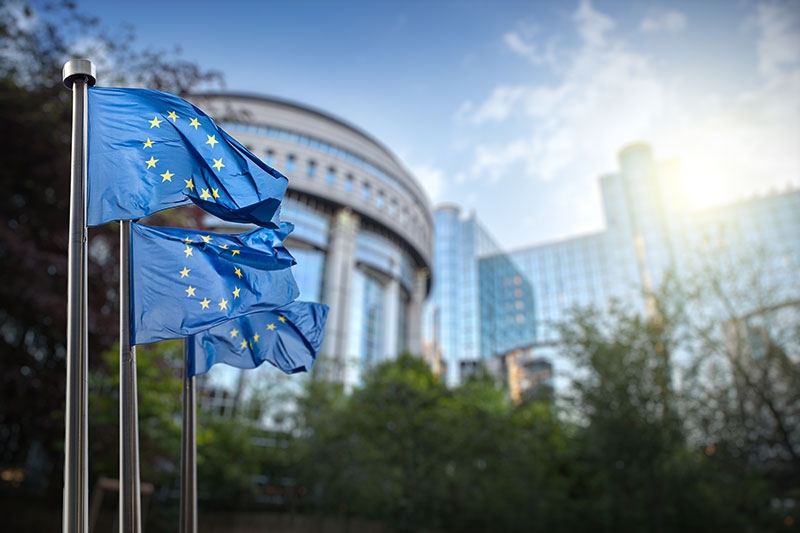
“The Global Business Travel Association (GBTA) warned that suspending visa-free travel would have a ‘large negative impact,’ including an additional 10 million annual visa applications to process. Additionally, the GBTA warned that if the United States retaliates with its own suspension of visa-free travel, it could mean approximately €2.5 billion in costs to EU citizens as roughly 8 million travelers would need to pay the $160 visa fee and other application costs.  The GBTA also cited an Oxford Economics study that projected a 23 percent decline in travel revenue for the U.S. and Canada as a result of a suspension, as well as a projected 140,000 jobs lost in Europe and 73,000 jobs lost in the United States.”

Read more: http://www.travelagentcentral.com/destinations/gbta-suspension-visa-free-travel-between-u-s-and-eu-would-have-negative-consequences

Scan to Donate Bitcoin to Freedomwat.ch Staff
Did you like this?
Tip Freedomwat.ch Staff with Bitcoin

The West Is Closing Its Doors – To Westerners Themselves

A great trend reversal is taking place.  The latest evidence is that of the 27-year wife of a Briton and mother of two being jailed and facing deportation to her native Singapore after having cared for her dying parents, as well as that of a well-known Australian author being detained for nearly two hours and treated as a suspect upon entry to the U.S.

For nearly a generation, doors and markets alike were increasingly open to citizens of Western countries.  But governments are now not only slamming the doors shut to tourists and immigrants, but are in increasingly casual fashion even using the mobility of their own citizens as political bargaining chips.

Multiple citizenship, once maligned as a sign of divided loyalty and targeted for elimination in a 1963 treaty, was instead gradually legalized in most countries, including the U.S. in 1992.  A second or third passport even became sought-after by those with significant financial wealth seeking to diversify holdings and create tax-efficient investment plans.

Visa-free travel expanded broadly; a German passport now entitles the holder to enter a whopping 177 countries without filling out invasive, self-contradictory forms and paying onerous fees to various middlemen for the privilege of merely asking permission to cross a border.

Tourism revenue tripled since the fall of the Iron Curtain and dozens of countries flung open their borders, hungry for middle-class visitors and the increasing discretionary income they brought with them.

But not since the World War I-era nativist progressive Republican panic over Italians, Irish and German immigrants resulted in renamed foods, language bans, and the 1924 quota act imposing immigration quotas; not since Mexicans were deported en masse during the Great Depression; not since wartime panic over Italian, Japanese and German immigrants led to the institution of registration requirements in 1939 that threatened all immigrants with deportation; not since thousands of Japanese-Americans were indefinitely imprisoned without trial in 1942; and not since a 1978 law made passports mandatory for travel in peacetime has the U.S. government made such a stark reversal in its attitude towards travel and trade as since the year 2001 and the 9/11 terrorist attacks.

And other Western countries are following the U.S. example and making sharp course corrections of their own in the direction of increasing state surveillance, control, and discretion over the movement of the middle class.  Both Canada and the UK have  enacted schemes in which passports can be canceled unilaterally without a court hearing, and the EU is using the threat of ending visa-free travel as a bargaining chip with the US government.

Given that the risk of being killed by a law enforcement officer is nearly an order of magnitude greater than that of succumbing to a terrorist attack, it is time to rethink the policy of placing guns and arbitrary authority in between people and the places they want to go.


Scan to Donate Bitcoin to Freedomwat.ch Staff
Did you like this?
Tip Freedomwat.ch Staff with Bitcoin

Illinois Skips $9.1B Interest Payment on Pension Debt

“You read that right: They’re not going to pay.  It’s not just Illinois facing crippling pension liabilities: It’s also happening in California and New York.”

Read more: https://www.edelsonwave.com/real-wealth/illinois-passes-on-pension-debt/

Scan to Donate Bitcoin to Freedomwat.ch Staff
Did you like this?
Tip Freedomwat.ch Staff with Bitcoin

Australia Joins The War On Cash While Venezuela Backtracks Cash Ban

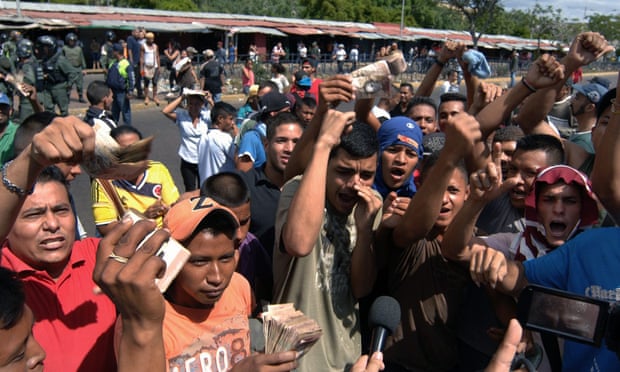
The Venezuelan government, amid looting, protests, shootings, and extremely long lines at banks, decided that its ban on the most circulated 100-bolivar note was ill-advised at this time.

The Indian government caused its own outbreak of chaos and deaths by banning 500- and 1000-rupee bank notes, worth about $7 and $14 respectively.  Amid the ensuing long lines and protests, in at least 6 cases bank employees were arrested aiding their customers in the conversion of banned notes.  Indians have been employing a number of workarounds to get their cash converted to the new notes, but others have been simply buying gold from vendors.  The government’s response is to now push for the income-tax office’s raids on families to target not only cash holdings, but gold as well.

An article in The Economist enumerates the failures of the India demonetization initiative:

  • 98% of economic transactions in India are done in cash
  • Four-fifths of India’s workers are paid in cash
  • Estimates of annual GDP growth now include a 2% decline due to payments drag
  • The new notes are smaller and only a subset of ATMs can handle them
  • $22 billion in notes are to be replaced; only $3 billion worth can be printed per month
  • The flood of deposits into banks were used to buy bonds, depressing interest rates

The cash ban has also caused a diplomatic row, as a flight to the safety of US dollar notes and the ensuing shortage of dollars has left Pakistan unable to pay its diplomatic staff in India.

Turning a blind eye to the chaos in other countries that are banning their own citizens’ cash, the head of the Australian tax office suggested banning the Australian $100 note in an explicitly stated attempt to raise tax revenue.  Earlier in the year, a surprise $34 billion increase in the Australian budget deficit over four years had been acknowledged.

Developed-world governments are joining their developing-world counterparts in governing by surprise and openly placing their citizens’ wealth at risk through anti-cash messaging and actions.

The stated reasons usually range from fighting the drug black market (created by global drug prohibition) to fighting terrorists (often created, funded, and armed by developed-world governments) to fighting tax avoidance, which could be fought more effectively by lowering tax rates and eliminating burdensome paperwork and reporting requirements.

However, regardless of the stated reasons, the underlying motivation is to move cash-based activity into banks.  This benefits the global ruling class in several ways.

The banks and other financial middlemen win, because every transaction will subsequently have fees attached.

After all, depositors at a bank are no longer the bank’s true customers, thanks to privileged credit facilities at the central bank, state-sponsored deposit and loan guarantees, and myriad banking regulations erecting barriers to entry and thereby fostering consolidation of bank ownership.  Banks can survive without customers’ deposits, thanks to state backing, but they cannot survive without regulatory compliance.  In the cashless society, the banks will have an army of new unwilling customers from whom to extract fees, without being subject to the otherwise countervailing market force of consumer choice.

And the state wins, because all depositors’ economic activity is transparent to it through its control over the banks, making tax collection more thorough and dragnet surveillance more comprehensive.  The state can also, through its control over the banks, order accounts frozen at will.  This could prevent, for example, a defendant in a government action from retaining a specialist lawyer that could mount an effective defense, which wouldn’t be a problem if he had cash.

Other than control, the state can directly profit from cash bans: notes that are not turned in can be cancelled and converted into a ‘fiscal stimulus’ windfall for the state, a strategy openly floated during India’s cash ban.

Workers and savers lose; who else loses?  As a Telegraph article describes, a cashless society would be a nightmare for the homeless, who generally do not possess the proper paperwork to satisfy the state’s requirements to open a bank account.  Suddenly the class warfare inherent in cash bans comes into focus, and not in a way that was expected.

As The Economist states:

India is not the first country to introduce abrupt, drastic reform of its currency. But the precedents—including Burma in 1987, the former Soviet Union in 1991 and North Korea in 2009—are not encouraging. Burma erupted in revolt, the Soviet Union disintegrated and North Koreans went hungry.

Governments that now seek to ban cash in partnership with banks should consider whether they wish to be in the company of the above countries, whether in their motivation or in the outcome.

Scan to Donate Bitcoin to Freedomwat.ch Staff
Did you like this?
Tip Freedomwat.ch Staff with Bitcoin

Greek Taxes Are So High That People Are Turning Down Inheritances

“People once hoped that if they came into property they could sell it and live easier; now they fear that they will be unable to sell it and the taxes will drag them down. …After many years in which only very valuable properties were taxed, many Greeks went from paying almost no taxes on real estate to not having enough money to pay.”

https://fee.org/articles/greek-taxes-are-so-high-that-people-are-turning-down-inheritances/

Scan to Donate Bitcoin to Freedomwat.ch Staff
Did you like this?
Tip Freedomwat.ch Staff with Bitcoin

Illinois Enters the Fiscal Death Spiral

“The class-warfare tax hike in 2011 was a terrible signal to investors and entrepreneurs.  Illinois already was losing both taxpayers and taxable income during the first decade of the century and the tax increase accelerated the process.  And keep in mind that the state also has a gigantic unfunded liability because of absurd promises of lavish pensions and fringe benefits for state and local government employees.  It’s almost as if the politicians in Springfield want to make the state unattractive.”

Read more: https://fee.org/articles/illinois-enters-the-death-spiral/

Scan to Donate Bitcoin to Freedomwat.ch Staff
Did you like this?
Tip Freedomwat.ch Staff with Bitcoin

Venezuela becomes next country to ban its own money, citing vast conspiracy

“The announcement set off panic, as millions of people scrambled to round up their 100-bolivar bills and deposit them in bank accounts ahead of the arbitrary deadline. Everyday life — already disastrously precarious for many — was thrown into complete disarray as everyone from bus drivers to shop owners refused to accept the bills, realizing that there’s no point accumulating banknotes that will be worth nothing by the end of the week.”

Read more: https://www.washingtonpost.com/news/global-opinions/wp/2016/12/15/declaring-war-on-common-sense-venezuela-bans-its-own-money/#pt0-721087

Scan to Donate Bitcoin to Freedomwat.ch Staff
Did you like this?
Tip Freedomwat.ch Staff with Bitcoin

Dallas freezes pension fund withdrawals, plans bailout with 130% tax increase

Police and firefighter pensioners rushing for the exits to escape a government-run Ponzi scheme — the Dallas public-sector employee pension that had promised 8% annual returns — were hit with the news that further lump-sum cashouts would be denied thanks to a lawsuit by none other than the mayor of Dallas.

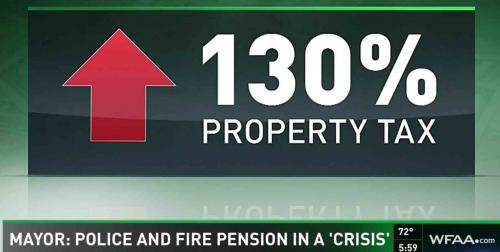
The city of Dallas pension board has recommended a 130% property tax rate increase with a goal of raising $1.1 billion to plug the present gap in the pension fund.

The pension fund had recently reached for yield in risky real estate investments, losing $320 million before filing a lawsuit against its investment advisory firm earlier this year.

Expect many more such revelations in defined-benefit plans such as pensions, annuities, and life insurance as ZIRP/NIRP run their course.


Scan to Donate Bitcoin to Freedomwat.ch Staff
Did you like this?
Tip Freedomwat.ch Staff with Bitcoin