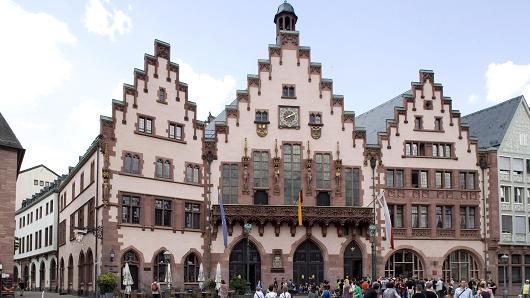
Germany sees dizzying rise in housing prices

“Major cities like Frankfurt, the financial capital, Munich with its famous beer gardens and proximity to the Alps and Stuttgart, the home of Mercedes and Porsche, are becoming increasingly attractive as a place to live and work. Germans from rural settings and immigrants are flocking to the cities.  But like in London, an equally potent driver of the property market in Germany is the good old ‘search for yield’.  Contrary to the U.K. though, it’s not Germany’s capital that is seeing the highest prices.  According to research from B+D, the most expensive properties in Germany are found in Munich (an average 4,800 euros ($6,427) per square meter).”

http://www.cnbc.com/id/101926645
Scan to Donate Bitcoin to Freedomwat.ch Staff
Did you like this?
Tip Freedomwat.ch Staff with Bitcoin
Italian economy minister delays goal of repaying state’s commercial debts

“The Italian state owes some 75 billion euros to private suppliers. The unpaid bills have starved companies of cash and triggered layoffs, factory closures and bankruptcies.  Prime Minister Matteo Renzi promised in March to pay back all the debt arrears by July. Within a week he put back the target date to September.  The government is finding it hard to tackle the problem because of public finance constraints, inefficiency, uncertainty over exactly how much is owed and a reluctance on the part of some public bodies to acknowledge their debts.  Italy is aiming to raise 8-10 billion euros from privatizations over the next two years to help cut its public debt.”

http://www.reuters.com/article/2014/07/06/us-italy-debts-minister-idUSKBN0FB0EB20140706

Scan to Donate Bitcoin to Freedomwat.ch Staff
Did you like this?
Tip Freedomwat.ch Staff with Bitcoin
Congress slams Fed’s permanent crisis lending proposal

“A bipartisan group of lawmakers on Monday urged the Federal Reserve to restrict its crisis lending programs for big banks.  Congress approved billions of dollars in 2008 to stabilize banks. In addition, the Fed launched its own programs, such as an overnight loan facility for primary dealers.  In all, the Fed provided more than $13 trillion to banks that relied on emergency lending programs for an average of 22 months, the letter said. ‘These loans were another bailout in all but name,’ the lawmakers said.  The group criticized rules the Fed proposed in December 2013 to implement the Dodd-Frank requirement that emergency programs provide liquidity to the entire financial system, not failing banks.”

http://www.baltimoresun.com/business/sns-rt-us-financial-regulations-fed-20140818,0,2845782.story

Scan to Donate Bitcoin to Freedomwat.ch Staff
Did you like this?
Tip Freedomwat.ch Staff with Bitcoin
Singapore’s central bank lost $10.2 billion fighting Bernanke [2013]

“Four men control over 70% of the world’s money supply, giving them control over the price of… everything.  And this system is so absurd that, healthy nations like Singapore are forced to lose billions in order to keep playing the game.  That’s exactly what it is– a game. Like most nations, Singapore has been playing this game for decades while the US changes the rules whenever it sees fit.  And it’s becoming obvious that the cost of playing is now far exceeding the benefit it receives. The hard numbers are very clear on this point.  This spells one inexorable conclusion, game over: a dramatic decline in the US dollar’s role as the global reserve currency in the next few years.”

http://www.sovereignman.com/trends/singapores-central-bank-lost-87-of-gdp-growth-fighting-bernanke-12665/

Scan to Donate Bitcoin to Freedomwat.ch Staff
Did you like this?
Tip Freedomwat.ch Staff with Bitcoin
The Fed in Danger

“The danger stems from a growing sense in Congress that the Fed has, with its program of quantitative easing and ultra-low interest rates, lengthened the Great Recession.  The Federal Reserve has just expanded its balance sheet by trillions of dollars. It is now holding trillions of Treasury notes and bonds that it ostensibly acquired on the open market but that represent, nonetheless, loans to the federal government from its own bank. These bonds were issued by the same Treasury Department with which Mrs. Yellen has been meeting with more or less weekly.  If Congress has a right to know what agreements have been made, what about the rest of us?”

http://www.nysun.com/editorials/the-fed-in-danger/88785/

Scan to Donate Bitcoin to Freedomwat.ch Staff
Did you like this?
Tip Freedomwat.ch Staff with Bitcoin

Fed Chairman Shrinks as Balance Sheet Grows

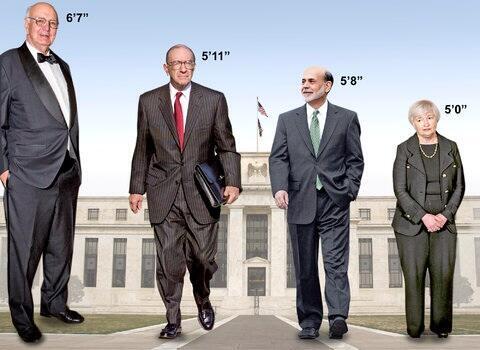
“With Janet Yellen’s confirmation as new Fed Chairman in the news, below is an awesome picture of the physical heights of the last four Fed Chairmen – Paul Volcker, Alan Greenspan, Ben Bernanke and Yellen.  The graphic was originally provided by the New York Times’s Economix blog, but today it is getting passed around on Twitter via @VolSlinger.  In the Times blog post about the topic on Nov. 11, they highlighted the downward trend in the fed fund rate.  Looking at it in an inverse way, however, shows as the Fed Chairman’s height falls the balance sheet balloons. The eight inches between Mr. Benanke and Ms. Yellen could mean a lot more growth!”

http://www.streetinsider.com/Fed/Fed+Chairman+Shrinks+as+Balance+Sheet+Grows/8894371.html

Scan to Donate Bitcoin to Freedomwat.ch Staff
Did you like this?
Tip Freedomwat.ch Staff with Bitcoin
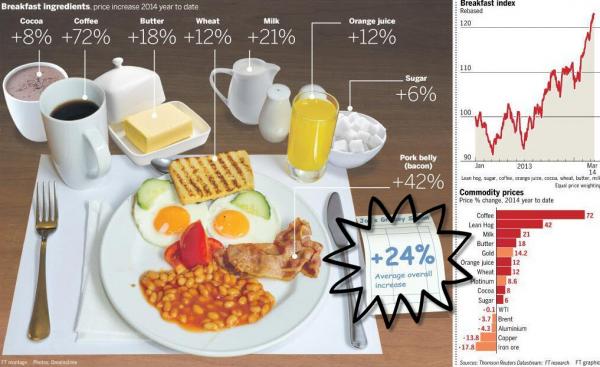
Foodflation – Since QE3, Breakfast Is Up Over 24%

“Having pointed out the ‘surges’ in the cost of your 4th of July burger at the behest of Greenspan and Bernanke, we thought a reflection on the soaring costs of ‘the most important meal of the day’ were in order. As the following chart illustrates in words and pictures even a PhD Fed economist or CNBC pretend-economist could understand – food-flation is here from breakfast through dinner (no matter how many iPads we try and eat).”

http://www.zerohedge.com/news/2014-07-06/foodflation-qe3-breakfast-over-24

Scan to Donate Bitcoin to Freedomwat.ch Staff
Did you like this?
Tip Freedomwat.ch Staff with Bitcoin

Bill Bonner: Three Signs That Never Fail to Predict a Bear Market

“Too much money (or credit) raises prices, lowers yields, forces investors into subprime investments, increases debt and dooms markets to disaster.   As ultra-low rates continue, milestones are hit. In 1946, the Union Pacific Railroad was able to borrow at 2.51% – a record low at the time. But it was a solid business. Today’s credit-financed lending bubble finds borrowers with neither tracks nor trains.  Rwanda recently borrowed $400 million – an amount equal to 5% of GDP –at less than 7% interest.  [LendingClub also has a] great business model, no? You get money from people who are desperate for yield… you lend it to people who are desperate for cash… and you take your fees off the top.”

http://bonnerandpartners.com/three-signs-that-never-fail-to-predict-a-bear-market/

Scan to Donate Bitcoin to Freedomwat.ch Staff
Did you like this?
Tip Freedomwat.ch Staff with Bitcoin

How to Handle the Coming Bond Market Bust

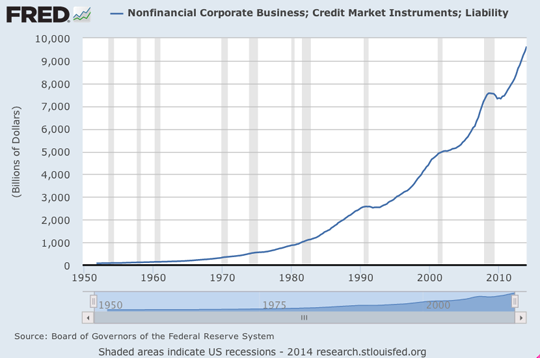
“One of the many consequences of the Fed’s ultra-low interest rates is that US corporations have gorged on credit.  In 2007, at the peak of the last credit bubble, US non-financial corporations had $7.2 trillion in outstanding debt. Today, they owe $9.6 trillion.  The Fed has built up a huge conflict of interest in its own policy making.  If it raises interest rates, it will depress the value of its balance sheet (which is now stuffed full of interest-rate-sensitive long bonds). But if the Fed backs off raising rates, for fear of the effect on bloated credit and stock markets, it risks losing all credibility… especially if the rate of consumer price inflation continues to rise.”

http://bonnerandpartners.com/how-to-handle-the-coming-bond-market-bust/

Scan to Donate Bitcoin to Freedomwat.ch Staff
Did you like this?
Tip Freedomwat.ch Staff with Bitcoin

What Happens When Share Buybacks Dry Up?

“Ultra-low rates cause investors to pile into increasingly poor investment choices – overvalued stocks, bonds, real estate, etc.  But ultra-low rates have other, more subtle, effects, too…  As we’ve been reporting, it also makes it extremely easy for corporations to borrow. And as the chart below shows, they’ve been borrowing like crazy recently.  What have they been doing with all this money?  One major source of spending has been share buybacks.  Over the past four years, share buybacks have totaled between $75 billion and $159 billion a quarter.  And in the first quarter of this year they reached a high exceeded only by a couple of quarters in 2007.”

http://bonnerandpartners.com/what-happens-when-share-buybacks-dry-up/

Scan to Donate Bitcoin to Freedomwat.ch Staff
Did you like this?
Tip Freedomwat.ch Staff with Bitcoin