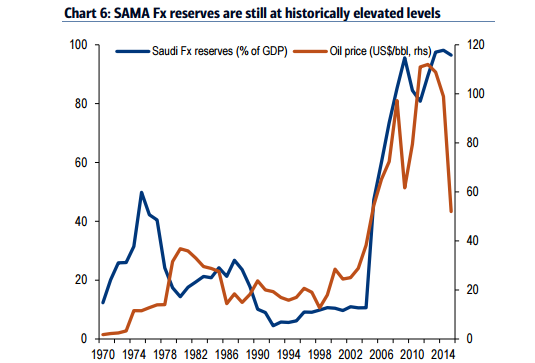
“Saudi Arabia should use its massive foreign exchange reserves to defend the riyal, amid fears the world is descending into a new phase of global currency wars, the World Bank has said. The kingdom’s shaky currency peg with the dollar has come under record pressure this week as the price of oil has plummeted to near 12-year lows. Central bank reserves have dropped from a peak of $735bn to around $635bn this year – a pace of spending which will exhaust the kingdom’s fiscal buffers within five years The monarchy has vowed to stick by the exchange regime and is instead planning to strengthen its coffers through the unprecedented flotation of its state-owned oil giant, Aramco.”
“In 1919, Thomas went on a lecture tour in the United Kingdom and United States, showing pictures of Lawrence posing in a sheikh’s robes in a London studio, and entranced audiences with stories about the ‘White King of the Arabs.’ By the time the Treaty of Sèvres was negotiated in 1920, with Lawrence in attendance and the media mob hanging on his every word, the British felt compelled to keep Lawrence’s promise to the chieftains of an Arab tribe called the Hashemites. The political structure of the Middle East today is the result of that promise. The Treaty of Sèvres permitted the British to seize pieces of the Ottoman Empire, which had ruled the Middle East for centuries.”
“A number of foreign liberals—Lithuanian, Russian, Slovakian, Swedish, for instance—have criticized American libertarians for advocating a non-interventionist foreign policy. They’ve instead argued that a ‘compelling’ argument can be made for a ‘globalist’ strategy. Actually, that’s true only so long as one isn’t paying the cost of the foreign policy. As foreigners typically do not for American intervention, unless it is directed at them. Nothing in liberal philosophy requires residents of the globe’s most powerful ‘liberal’ nation to bankrupt themselves, sacrifice their liberty, and court national destruction to try to remake the earth.”
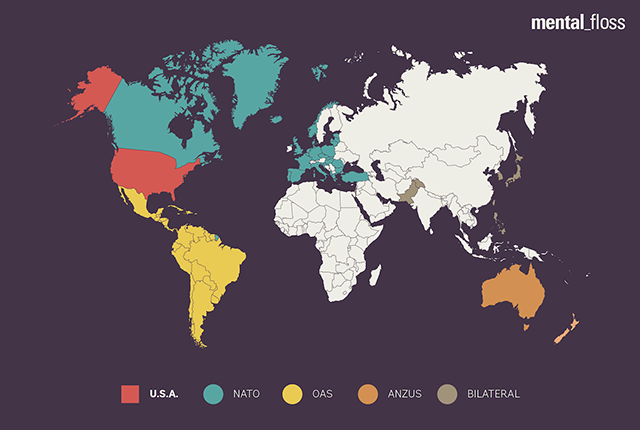
“The United States has entered a lot of treaties over the years, especially after the complicated network put in place after World War II. The Myth of Entangling Alliances by Michael Beckley sought to figure out a hard number for just how many countries the United States has agreed to defend in war. Thanks to NATO, ANZUS, OAS, and bilateral agreements, the U.S. has promised 67 countries protection. Here’s a look at the list included in Beckley’s paper.”
“Brussels is to propose the creation of a standing European border force that could take control of the bloc’s external frontiers — even if a government objected. The move would arguably represent the biggest transfer of sovereignty since the creation of the single currency. The blueprint represents a last-ditch attempt to save the Schengen passport-free travel zone, by introducing the kind of common border policing repeatedly demanded by Paris and Berlin. European leaders have discussed a common border force for more than 15 years, but always struggled to overcome deep-seated objections to yielding national powers to monitor or enforce borders.”
“The IMF will add the yuan to its basket of reserve currencies, an international stamp of approval of the strides China has made integrating into a global economic system dominated for decades by the U.S., Europe and Japan. It’s the first change in the SDR’s currency composition since 1999, when the euro replaced the deutsche mark and French franc. It’s also a milestone in a decades-long ascent toward international credibility for the yuan, which was created after World War II and for years could be used only domestically in the Communist-controlled nation. The IMF reviews the composition of the basket every five years and rejected the yuan during the last review, in 2010.”
“Get used to the possibility that your son or daughter might end up dying for Montenegro because that country has just been invited to become the latest member of NATO, the Cold War organization that was brought into existence to defend Europe from America’s World War II partner and ally, the Soviet Union. Just in case you’ve never heard of Montenegro or maybe don’t know where it is, here’s a link to Wikipedia’s page on the country: https://en.wikipedia.org/wiki/Montenegro. It seems to me that if your son or daughter might have to die in the defense of Montenegro, you might want to know a little about it or at least where it is located.”
“Central planners around the world are waging a War on Cash. In just the last few years: Italy made cash transactions over €1,000 illegal; Switzerland proposed banning cash payments in excess of 100,000 francs; Russia banned cash transactions over $10,000; Spain banned cash transactions over €2,500; Mexico made cash payments of more than 200,000 pesos illegal; Uruguay banned cash transactions over $5,000; and France made cash transactions over €1,000 illegal, down from the previous limit of €3,000. An increasing number of government restrictions are encouraging Swedes to dump cash. The pretexts are familiar…fighting terrorism, money laundering, etc.”
“Officials in several countries are wasting no time in trying to convince the public to trade essential freedoms for the promise of enhanced security. US officials are also eager to cash in on the panic with more powers, seeking to expand their ability to carry out mass surveillance, citing the largely toothless ‘reforms’ of NSA surveillance as proof that the US has intelligence ‘gaps’ that need to be filled by more intrusion into ordinary citizens’ affairs. Israeli Defense Minister Moshe Ya’alon was the least specific but the most direct, insisting that Paris proved the need to favor security over basic human rights, and predicting a massive shift toward more government power.”
“Today’s horrific attacks in Paris have moved us all, and the more we learn, the more our hearts ache,” said Governor Cuomo. “These were cowardly acts of evil by people who have inexplicably chosen to believe in radical hatred above all else.”
‘Inexplicable’; perhaps, for the pathologically dense.
Let France and all nations following its path know that they will continue to be at the top of the target list for the Islamic State and that the scent of death will not leave their nostrils as long as they partake in the crusader campaign, as long as they dare to curse our Prophet (blessings and peace be upon him), and as long as they boast about their war against Islam in France and their strikes against Muslims in the lands of the Caliphate with their jets, which were of no avail to them in the filthy streets and alleys of Paris. Indeed, this is just the beginning. It is also a warning for any who wish to take heed.
France? That effete land of art, fashion, and cheese?
It’s not as if they should be surprised. After all, if the Paris bombings were a reaction motivated by French foreign military adventures, we have seen this before. From the article:
This isn’t the first time France’s involvement abroad has led to terrorism at home. In 1995, Algerian Islamists set off eight bombing attacks that killed eight people and wounded 200 in Paris to punish France for supporting the government in that country’s civil war.
There is, however, said to be no specific intelligence indicating there is a direct terrorist threat to attack Britain. The heightened measures in the UK are partly to reassure the public [..]
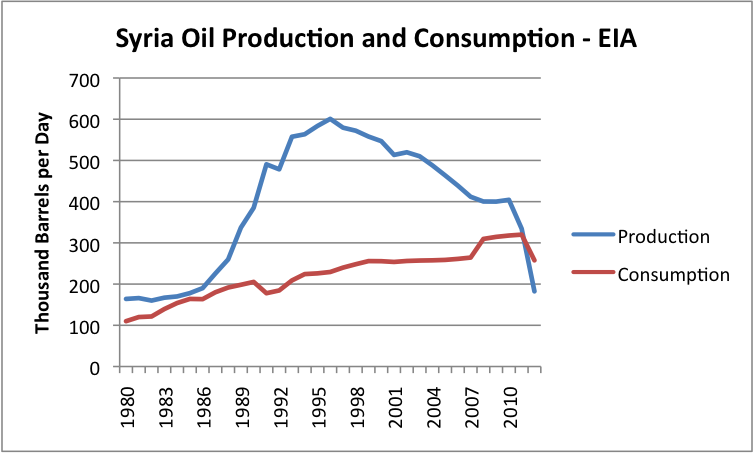
Knowing Syria was a critical piece in its energy strategy, Turkey attempted to persuade Syrian President Bashar Assad to reform this Iranian pipeline and to work with the proposed Qatar-Turkey pipeline, which would ultimately satisfy Turkey and the Gulf Arab nations’ quest for dominance over gas supplies, who are the United State’s allies. But after Assad refused Turkey’s proposal, Turkey and its allies became the major architects of Syria’s “civil war.”
Mainstream media outlets repeat the comfortable myth that terrorist attacks are primarily motivated by the desire to impose Sharia law in Western countries. While the precise mechanism by which random acts of violence lead to a formal Sharia law regime is yet to be identified, it is perhaps more instructive to examine the statements made by the attackers themselves, which invariably cite not only their religious beliefs, but specific acts of military violence carried out by U.S., NATO, and/or GCC partners in Middle Eastern countries. Two recent examples are the statements following the Charlie Hebdo and November Paris attacks.
But let’s step back to the bigger picture for a moment:
It is not hard to imagine that every one of these attacks that senselessly kills children, friends, and loved ones creates motivation to retaliate among those remaining. ISIS recruiters offer a vision of utopia to a generation of young people that has only known war, poverty, and personal tragedy.
Explaining the inexplicable: How can terrorists be gaining ground versus the most powerful governments in the world?
In Iraq, then Libya, then Egypt, former U.S.-backed authoritarians heading secular governments were deposed one by one. Saddam Hussein and Muammar Gaddafi were victims of openly executed military regime change operations, while Hosni Mubarak was the victim of a series of events that led to the present U.S.-backed military dictatorship. The latter was accomplished through an alphabet soup list of NGOs:
Washington’s democracy assistance programme for the Middle East is filtered through a pyramid of agencies within the State Department. Hundreds of millions of taxpayer dollars is channeled through the Bureau for Democracy, Human Rights and Labor (DRL), The Middle East Partnership Initiative (MEPI), USAID, as well as the Washington-based,quasi-governmental organisation the National Endowment for Democracy (NED).
In turn, those groups re-route money to other organisations such as the International Republican Institute, the National Democratic Institute (NDI), and Freedom House, among others. Federal documents show these groups have sent funds to certain organisations in Egypt, mostly run by senior members of anti-Morsi political parties who double as NGO activists.
The Middle East Partnership Initiative – launched by the George W Bush administration in 2002 in a bid to influence politics in the Middle East in the wake of the September 11 terrorist attacks – has spent close to $900m on democracy projects across the region, a federal grants database shows.
USAID manages about $1.4bn annually in the Middle East, with nearly $390m designated for democracy promotion, according to the Washington-based Project on Middle East Democracy (POMED).
The US government doesn’t issue figures on democracy spending per country, but Stephen McInerney, POMED’s executive director, estimated that Washington spent some $65m in 2011 and $25m in 2012. He said he expects a similar amount paid out this year.
A main conduit for channeling the State Department’s democracy funds to Egypt has been the National Endowment for Democracy. Federal documents show NED, which in 2011 was authorised an annual budget of $118m by Congress, funneled at least $120,000 over several years to an exiled Egyptian police officer who has for years incited violence in his native country.
This appears to be in direct contradiction to its Congressional mandate, which clearly states NED is to engage only in “peaceful” political change overseas.
We know where the military dictatorship gets its money and weapons. Where do terrorists get the money and weapons with which they can become an organized army, occupy territory, and train recruits?
The source of motivation for terrorist attacks is apparently not “inexplicable”. The means by which those attacks are carried out also does not seem to be at all “inexplicable”.
What may be the truly “inexplicable” and uncanny part of the process: the ability of Western governments and media to cultivate such mass ignorance that they are able to pretend to be mere victims of purportedly “inexplicable” attacks, thus enabling ever-ongoing seizures of extra-constitutional police and emergency powers that are unlikely to be relinquished voluntarily.
The Reichstag Fire in Nazi Germany was perhaps the template for this mechanism of permanent ’emergency’ escalations of state power, which has today evolved into a global phenomenon, fueled by ISIS and at the same time fueling ISIS through its reactions.
One could ascribe failures to stop future attacks on power elite ‘interests’ or on civilians to malice, or to incompetence instead, depending on your perspective.
What’s the answer?
Interpret the latest attack as another datapoint indicating failure of the policy, and reverse course. Withdraw from foreign military occupations, renounce illegal emergency powers and secret spying on citizens, convert payments to foreign militaries and governments into aid for war victims including resettlement domestically, and sweep away the hubristic ruling class ideology that enabled this global human rights catastrophe and policy disaster in the first place.
Which course will the U.S. and NATO governments pursue from here? Perhaps a course they could have chosen almost 10 years ago that would certainly not have trained and armed ‘friendly’ terrorists, would certainly have not motivated young people to join terrorist organizations with more anger-inducing tragedies, and would certainly not have deliberately destabilized an entire region of the globe through armchair regime change pursuits.
Only a madman would repeat the same courses of action and expect differing results. So are Western leaders mad, or are they openly pursuing the same results?
Did you like this? Tip Freedomwat.ch Staff with Bitcoin