
Did you like this?
Tip Freedomwat.ch Staff with Bitcoin
Tip Freedomwat.ch Staff with Bitcoin

“Bitcoin heists are actually not uncommon. In June of 2011, a user named Allinvain was the victim of what is arguably the first recorded major Bitcoin theft. There have been dozens of Bitcoin thefts since then. The supposedly high-return investment fund Bitcoin Savings & Trust turned out to be a pyramid scheme, its owner charged with ripping off investors for $4.5 million in bitcoins. MyBitcoin, a ‘wallet’ service that stored bitcoins like a bank account, disappeared with about $1 million worth of users’ bitcoins. Several of the most trusted and well-known Bitcoin companies, including the Mt. Gox and the now-defunct Bitcoinica exchanges, have also suffered high-profile thefts.”
http://www.theverge.com/2013/12/19/5183356/how-to-steal-bitcoin-in-three-easy-steps
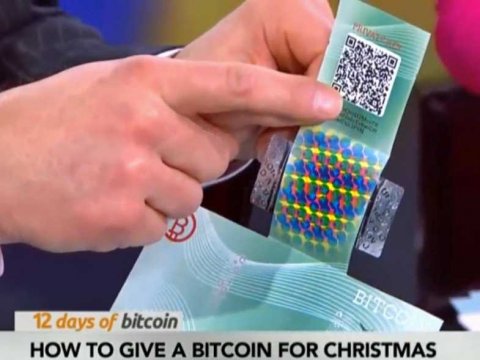
“Bloomberg TV’s Matt Miller is currently experiencing the ’12 Days Of Bitcoin,’ a series for the business news television station. On Friday, Miller learned an important lesson. It was an experience that everyone should remember before they start moving their money into the digital currency. While on air, Miller surprised Bloomberg anchors Adam Johnson and Trish Regan each with $20 worth of Bitcoin. But as Johnson received the paper gift, he briefly exposed the QR code (see above). This act was effectively like sharing a bank account and PIN number. Immediately, someone lifted the QR code and stole the $20.”
http://www.businessinsider.com/bloomberg-matt-miller-bitcoin-gift-stolen-2013-12
“Brian Krebs, the venerable security journalist who first reported the insane Target Holiday Security Breach that exposed up to 40 million credit cards, has located one of the black market sites selling the card information and says they are going for $20 to $100 each. They can be bought using, of course, Bitcoin, as well as other irreversible and semi-anonymous ways of sending money including Litecoin, WebMoney, PerfectMoney, and traditional wire transfers. Krebs went shopping on the black market to help a small New England community bank which has 120,000 cards in the wallets of its customers and wanted to know how many of them are for sale for fraudsters this holiday season.”
http://www.forbes.com/sites/kashmirhill/2013/12/20/target-credit-cards-are-selling-for-20-100-each/

“Retailers are an appealing target for hackers during the holidays, and Target may be learning that lesson the hard way. According to Krebs on Security, the US retail giant is investigating a major breach that could potentially involve ‘millions’ of customer credit and debit card records. The sophisticated hack reportedly took place over several weeks — starting on Black Friday and possibly extending all the way through December 15th — and is said to involve ‘nearly all’ Target stores in the United States. Krebs says the breach ‘involves the theft of data stored on the magnetic stripe of cards used at the stores.'”

“BitTorrent, Inc. is developing a serverless instant messaging system that relies on public key encryption to protect the privacy of communications, identifying users not with traditional usernames but with cryptographic key pairs. The company, which develops the BitTorrent peer-to-peer protocol as well as the BitTorrent and μTorrent file sharing software, announced the forthcoming chat software in September and revealed some details on how it will work in a blog post today. Underlying this system is a Distributed Hash Table (DHT) which finds IP addresses, removing the need for a central server to route messages, the company explained.”
“Documents leaked by the former NSA contractor Edward Snowden show that the NSA created and promulgated a flawed formula for generating random numbers, to create a ‘back door’ in encryption products, the New York Times reported in September. Reuters later reported that RSA became the most important distributor of that formula by rolling it into a software tool called Bsafe that is used to enhance security in personal computers and many other products. Undisclosed until now was that RSA received $10m in a deal that set the NSA formula as the preferred, or default, method for number generation in the BSafe software, according to two sources familiar with the contract.”
http://www.theguardian.com/world/2013/dec/20/nsa-internet-security-rsa-secret-10m-encryption
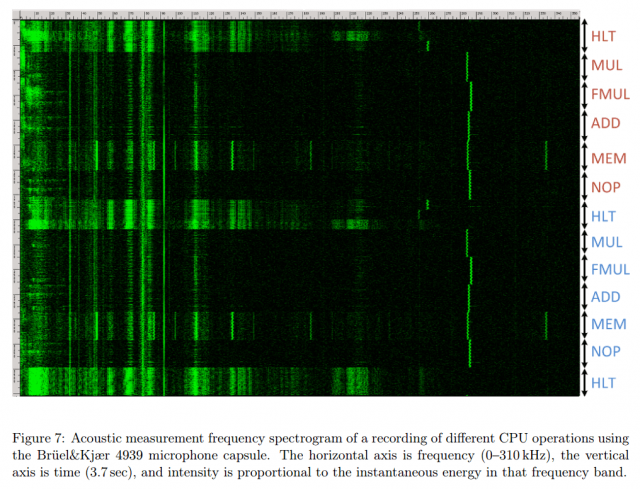
“Security researchers have successfully broken one of the most secure encryption algorithms, 4096-bit RSA, by listening – yes, with a microphone — to a computer as it decrypts some encrypted data. The attack is fairly simple and can be carried out with rudimentary hardware. In this case, the security researchers listen to the high-pitched (10 to 150 KHz) sounds produced by your computer as it decrypts data. The researchers successfully extracted decryption keys over a distance of four meters (13 feet) with a high-quality parabolic microphone. They also managed to pull of this attack with a smartphone placed 30 centimeters (12 inches) away from the target laptop.”
“FIDO hopes to replace passwords with a system built around public key cryptography. To register with a FIDO site, you won’t enter a password into the site. Instead, hitting register will alert your authentication devices—typically an app on your smartphone—of the attempt to register. If that attempt is approved (for example, by using a registered fingerprint or entering a PIN), the device will generate a public/private key pair. The public key will be sent to the online service; the private key will be retained on the authentication device.”

“The U.S. National Security Agency (NSA) has the technical capacity to crack the most commonly-used cellphone encryption technology, and in doing so it can decode and access the content of calls and text messages. Citing a top-secret document leaked by Edward Snowden, the report states that the agency can easily break a technology called A5/1, the world’s most common stream cipher used to encrypt cellular data as it transmits to cell towers. AT&T, the largest GSM provider in the U.S., is in the process of upgrading its networks to what’s called A5/3 encryption, the Post reports, which requires 100,000 times more computing power to break compared to A5/1.”
http://mashable.com/2013/12/13/nsa-cellphone-encryption/