“Sometimes, we find that what we are doing is something other than what we really want to do. It is never too late to ask, ‘Am I doing what I want to do? Is it giving me all of the benefits I want and need? How close is it to my perfect job?’ Take a few moments now to think about it. It might help to look at this brief list that identifies what, for me, are the most important characteristics of the perfect job: I would be happy to do the work I do for free; I believe it has value — to me and to the people who pay me for it; It is fully challenging. It engages both the logical and the creative sides of my brain.”
Monthly Archives: October 2013
5 Ways Your Brain Tricks You Into Making Horrible Investment Decisions
Venezuela’s President Sets Up a “Ministry of Supreme Social Happiness”

“How could I possibly top Bill Clinton’s call for a Ministry of Truth for the Internet? ‘A new Vice Ministry of Supreme Social Happiness has been created by Nicolas Maduro, the Venezuelan president, in an attempt to coordinate all the ‘mission’ programmes created by Hugo Chavez to alleviate poverty. Oil-rich Venezuela is chronically short of basic goods and medical supplies. Annual inflation is running officially at near 50 per cent. Housewife Liliana Alfonzo, 31, said that instead of a Supreme Happiness agency she would prefer being able to get milk and toilet paper, which disappear off store shelves minutes after arriving at stores.'”
http://www.economicpolicyjournal.com/2013/10/venezuelas-president-sets-up-ministry.html
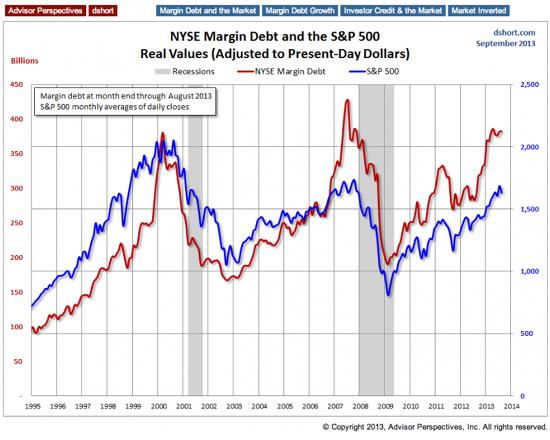
A Tale of Two Charts: Are We 2007 America or 2006 Zimbabwe?

“See the next chart, which tracks the S&P 500 and margin debt, the amount of money investors are borrowing against their shares of stock to buy more stock. The chart seems to show that when investors are optimistic enough to use leverage to invest in already-risky stocks, then the good times have pretty much run their course and something nasty is imminent. If recent history is our guide, it is now time to either take some money off the table or short the hell out of the big indexes – or whatever else you like to do when the market looks overbought. But this conclusion is only valid if we’re in the same stage of the credit bubble as during those two previous sentiment peaks.”
Dubai to Add Spot Gold Contract

“About a quarter of all the physical gold traded around the world already passes through Dubai, the commercial hub of the United Arab Emirates, but DGCX, as the exchange is known, is looking to continue expanding this trade, which has grown from $6 billion in 2003 to $70 billion last year, according to data from the Dubai Multi Commodities Centre. This is part of a trend that is seeing the volume of gold passing through established gold-trading venues in the West—London, New York and Zurich—gradually shifting eastward, to Dubai, Singapore, Hong Kong and Shanghai. Souks are still hives of gold-trading activity in Dubai, which boasts around 300 gold retailers.”
http://blogs.wsj.com/moneybeat/2013/10/29/dubai-to-add-spot-gold-contract/
What the Fed Can Learn From the McDonald’s Dollar Menu

“We live in parallel universes. Federal Reserve Chairman Ben Bernanke is said to have a healthy concern about deflation. McDonald’s franchisees, on the other hand, not so much. The chain of Golden Arches fame will give up its Dollar Menu after 11 years, renaming it ‘The Dollar Menu & More’ next month. It turns out you simply can’t make a buck selling burgers for a buck. It must be hard to give up on such an amazing marketing gimmick, generating one-seventh of all sales since its inception. If Ben Bernanke is paying attention, he is no doubt thrilled to hear about rising price pressures.”
http://lfb.org/today/what-the-fed-can-learn-from-the-mcdonalds-dollar-menu/
The Good News Is That the Bad News about Kansas Was Wrong
“When Kansas cut its taxes, Oklahoma’s tax consumers predicted fiscal collapse or stress for our neighbors. Various Republican policymakers joined the chorus. But often, he or she who dares, wins. Kansas and Oklahoma have taken different courses. In the former, liberty is incrementally advancing. In the latter, government is incrementally advancing. It is not hateful or mean-spirited to say this: These are factual statements. As OCPA’s fiscal policy director Jonathan Small told me: ‘Fundamentally, Governor Brownback and many lawmakers in Kansas have determined they truly believe that more dollars left with their citizens is better than any government spending they may choose.'”
No Dorothy, US Capital Controls Haven’t Been Imposed

“It’s true that the US government could impose capital controls almost instantly. All it would take would be a flick of President Obama’s pen. The bigger question is ‘why?’ Governments have imposed capital or “foreign exchange” controls for more than 2,000 years, starting with the ancient Greeks. The reason has always been the same—to maintain the value of a declining currency. On the other hand, if a country’s currency is going up in value, or at least stable, there’s no reason to restrict the flow of capital across borders. So will the USA impose capital controls? I think it’s extremely unlikely—at least in the next few years.”
http://nestmann.com/no-dorothy-us-capital-controls-havent-been-imposed
BMC Software loses $13 million to IRS after repatriating $717.2 million
“In a decision that could have implications for other companies in similar disputes with the IRS, the Tax Court said BMC owes taxes on a portion of its foreign profits brought into the United States under the 2004 tax break. In 2004, President George W. Bush signed into law a repatriation holiday that allowed multinational U.S. businesses to bring foreign profits into the United States at a 5.25 percent tax rate, rather than the then current 35 percent rate. In 2005, BMC repatriated $717.2 million. Analog Devices Inc, a Massachusetts-based circuit-maker, has a similar dispute over $26 million pending with the IRS.”
http://finance.yahoo.com/news/bmc-software-loses-13-million-215243449.html
IRS to Protect Computer System Modernization From Budget Cuts [2011]

“The plan suffered expensive glitches a decade ago and so far has cost $3.7 billion. Contractors on the project include Computer Sciences Corp. (CSC), based in Falls Church, Virginia; New York-based Deloitte Consulting LLP; andLockheed Martin Corp. (LMT), based in Bethesda, Maryland, according to Bloomberg Government data. The heart of the modernization effort involves building a database, known internally as CADE2 and projected to cost at least $1.3 billion through 2024. So far, the IRS has spent about $172 million on what some in the Government Accountability Office and the tax agency call a crown-jewel database, with $66 million going to CSC.”