“Presidential fear-mongering has a long and sordid history. We cannot understand the threat that Trump poses without recognizing how prior presidents used similar ploys.”
Category Archives: Essays
John Whitehead, The FBI: The Silent Terror of the Fourth Reich

“Lately, there’s been a lot of rhetoric comparing Donald Trump to Adolf Hitler. The concern is that a Nazi-type regime may be rising in America. That process, however, began a long time ago. In fact, following the second World War, the U.S. government recruited Hitler’s employees, adopted his protocols, embraced his mindset about law and order, implemented his tactics in incremental steps, and began to lay the foundations for the rise of the Fourth Reich.”
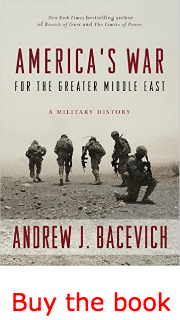
Andrew Bacevich: How We Got Here

“To focus on the man himself rather than on the circumstances that produced him is to miss the significance of what has occurred. Note, for example, that his mandate is almost entirely negative. It centers on rejection: of globalization, of counterproductive military meddling, and of the post-Cold War cultural project. Yet neither Trump nor any of his surrogates has offered a coherent alternative to the triad of themes providing the through line for the last quarter-century of American history.”
Read more: http://www.tomdispatch.com/post/176228/tomgram%3A_andrew_bacevich%2C_how_we_got_here/
Your Right to Use Encryption

“Today, encryption is used in many areas beyond traditional communications — it’s what ensures that our online bank accounts are secure; it can prevent someone from snooping on your Internet traffic at a coffee shop; and, most importantly, it’s what we rely on to secure our personal devices, like smartphones and computers, which contain our entire lives. Government officials have started pushing for ‘backdoors,’ where an encryption system is intentionally weakened so that government can access whatever data it wants. But this idea is a nonstarter.”
Read more: https://fee.org/articles/your-right-to-use-encryption/
Race to the Bottom: Injuring the Real Economy with Paper “Wealth”
“The ECB and the Bank of England have purchased so much government debt that they have recently reached even further down the credit ladder, with the ECB buying corporate bonds, and the Bank of England announcing purchases of ‘Tier C’ assets, which include assets ‘backed by credit cards; student loans; and consumer debt.’ Unfortunately, this isn’t backing at all. When will it end? It will end as credit defaults rise, bank bailouts become necessary, covenant lite debt proves to be, indeed, lite on covenants, and financial assets pushed to zero long-term yields prove, indeed, to yield zero returns over the long-term.”
John Hussman: Brexit and the Bubble in Search of A Pin
“Think of the EU, in its current ill-structured form, as a kind of Ponzi scheme, and Britain as the guy who just asked for his money back. There are undoubtedly greater prospects for near-term disruption after last week’s vote, but the hallmark of a Ponzi scheme is the attempt to use progressively greater distortions in order to preserve a structure that is fundamentally unsound and increasingly bankrupt. Of any large country that could leave the EU, Britain was the best first mover. I have no immediate concerns about a domino effect, but if one was to emerge, my view is that the exit of Germany, France, and the Nordic countries would be preferable to the exit of Greece, Italy, Spain, or Portugal.”
John Hussman: Over-Adaptation and Market Drawdowns

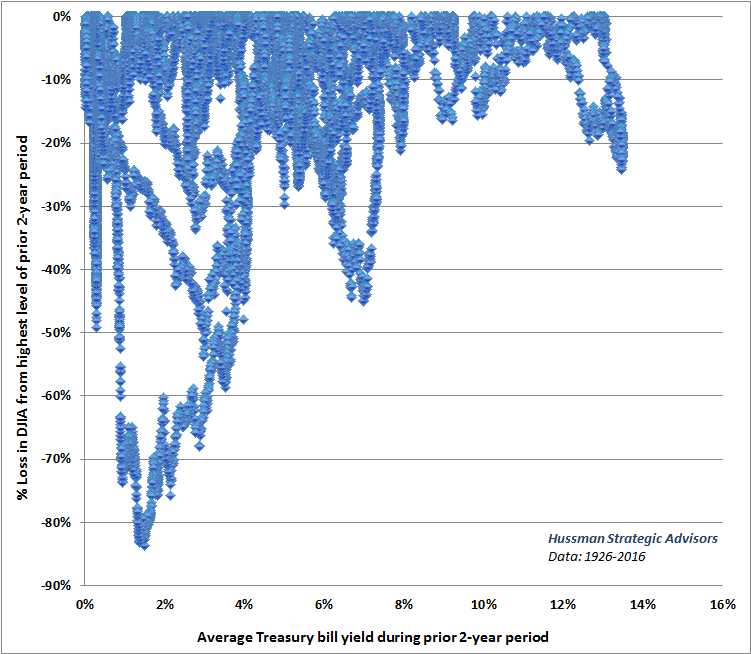
“The worst market losses across history have been associated with relatively low short-term interest rates during the collapse and the absence of any material hike in interest rates at all as the collapse unfolds. Investors have convinced themselves to tolerate historic valuation extremes, confident that stocks can’t fall unless interest rates rise. They’ve walked right into this setup because they don’t recognize it, and neither central bankers nor the investment profession appear interested in admitting the increasingly pressing risks that they themselves have been complicit in creating.”
John Hussman: Bearishness Is Strictly For Informed Optimists

“When the primary use of fiscal policy is to wipe up the catastrophe of weak productivity, lost income, unemployment, and malinvestment created in the repeated aftermath of collapsed financial bubbles, the endgame is going to be stagnant living standards and a debased currency. Ultimately, QE may finally create inflation by provoking a loss of fiscal control. Central banks have risked just that by encouraging yet another speculative bubble, heavy issuance of low-grade debt, and the diversion of savings toward unproductive investment. The inevitable fiscal consequences are likely to include bailouts, income-replacement and transfer payment programs as the third bubble since 2000 collapses.”
David Stockman, Christmas 2015—–Why There Is No Peace On Earth

“The real threat to peace circa 1990 was that Pax Americana would not go away quietly in the night. In fact, during the past 25 years Imperial Washington has lost all memory that peace was ever possible at the end of the cold war. Today it is as feckless, misguided and bloodthirsty as were Berlin, Paris, St. Petersburg, Vienna and London in August 1914. The modern Warfare State has been the incubator of American imperialism since the Cold War, and is now proving itself utterly invulnerable to fiscal containment, even in the face of a $19 trillion national debt. So 101 years after the Christmas truces along the Western Front there is still no peace on earth.”
http://davidstockmanscontracorner.com/christmas-2015-why-there-is-no-peace-on-earth/
Bill Bonner: The Curse of Lawrence of Arabia [2002]
“In 1919, Thomas went on a lecture tour in the United Kingdom and United States, showing pictures of Lawrence posing in a sheikh’s robes in a London studio, and entranced audiences with stories about the ‘White King of the Arabs.’ By the time the Treaty of Sèvres was negotiated in 1920, with Lawrence in attendance and the media mob hanging on his every word, the British felt compelled to keep Lawrence’s promise to the chieftains of an Arab tribe called the Hashemites. The political structure of the Middle East today is the result of that promise. The Treaty of Sèvres permitted the British to seize pieces of the Ottoman Empire, which had ruled the Middle East for centuries.”