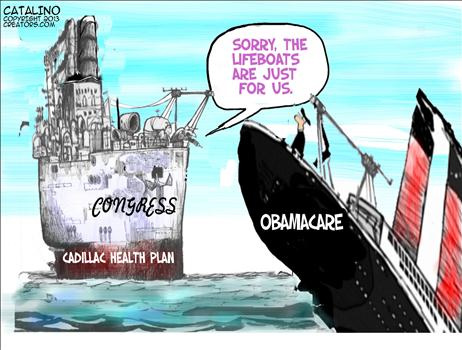

“Paul said, ‘I think we all want more people to have insurance. What my fear is is that he’s going to make insurance so expensive that the people who currently have insurance may lose their insurance.’ The senator sounded off on reports that another provision of ObamaCare would be delayed, blasting the president for changes laws without Congress’ approval. ‘The president doesn’t get to write legislation, and it’s illegal and unconstitutional for him to try and change legislation by himself,’ he said.”

Tag Archives: Dr. Government
Obamacare: “Let’s Just Make Sure It’s Not A Third World Experience”

“We begin today by checking our premises: In order to imagine something working forever, it must begin to work in the first place. When asked last Friday about what the future holds for the Affordable Care Act, Senate Majority Leader Harry Reid said, ‘What we’ve done with Obamacare is a step in the right direction, but we’re far from having something that’s going to work forever.’ The law takes full effect Jan. 1, 2014, and the online exchanges launch on Oct. 1, 2013. But lofty expectations are being played down as logistical problems become worse and worse.”
http://dailyreckoning.com/obamacare-lets-just-make-sure-its-not-a-third-world-experience/
‘Affordable’ Care: $1 Pay Hike Costs Middle-Class Family $9,355 Hike in Premiums

“When the Patient Protection and Affordable Care Act (AKA Obamacare) is fully enforced on individuals and families next year, a middle-aged, middle-class couple with three children could be hit with a $9,355 hike in their annual health-insurance premiums if their annual household income happens to increase by just $1. According to the IRS, which responded to a CNSNews.com inquiry on the issue, a household earning an annual income that is just $1 more than 400 percent of the FPL is ineligible for an Obamacare subsidy, period. A family of four, in which both parents were 56 years old, would hit the 400-percent of FPL threshold at $94,200.”
Wyoming weed laws leave patients with difficult choice: suffer or risk imprisonment

“For a law-abiding Casper resident with impaired vision and glaucoma, it proved a tough decision: Take expensive legal medicine, with the side effects, or use marijuana and risk imprisonment. ‘It’s a real frustrating thing – do you want to risk your freedom or do you want to lose your vision?’ He said. ‘It’s not a choice you should have to make.’ He’s not the only one to make that choice. After a motorcycle accident in 1997 shattered his pelvis and crushed his left leg from the knee down, Charlie Lake underwent 13 surgeries that left him in chronic pain. Lake said [opiate addiction] caused ‘mental anguish’ and other health problems until he began using marijuana.”
CFR Reports on Deadly Viruses That Become the Property of Sovereign Nations
“CFR Senior Fellow for Global Health Laurie Garrett writes, ‘Like the SARS virus, MERS ravages the lungs of infected people, causing pneumonia and acute respiratory distress. …But unlike SARS, it also attacks the kidneys, causing renal failure.’ ‘There is no cure, rapid diagnostic test, or vaccine for MERS-CoV,’ Garrett adds. But the ability to develop a treatment for the epidemic is being impeded by a concept known as ‘viral sovereignty’ – the idea that deadly viruses are the property of sovereign nations.”
http://www.economicpolicyjournal.com/2013/05/council-on-foreign-relations-reports-on.html
Questions and Answers About Cannabis – National Cancer Institute

“The use of Cannabis for medicinal purposes dates back at least 3,000 years. It came into use in Western medicine in the 19th century and was said to relieve pain, inflammation, spasms, and convulsions. Studies in mice and rats have shown that cannabinoids may inhibit tumor growth by causing cell death, blocking cell growth, and blocking the development of blood vessels needed by tumors to grow. Laboratory and animal studies have shown that cannabinoids may be able to kill cancer cells while protecting normal cells.”
http://www.cancer.gov/cancertopics/pdq/cam/cannabis/patient/page2
New Study Finds THC Kills Stomach Cancer Cells

“A new study conducted by the the Catholic University of Korea, College of Medicine, and published in the journal Anticancer Research, has found promising evidence that THC may be the best medicine available to treat stomach cancer, especially when traditional medicine has been ineffective. During the study researchers used cancer cells that were resistant to chemotherapy, and dosed the cells with a synthetic form of delta-9 tetrahydrocannabinol (THC). Researchers noted a drastic reduction in the survival rate of the cells that were exposed to the synthetic THC. Larger doses of THC led to higher rates of cancer cell death.”
http://www.theweedblog.com/new-study-finds-thc-kills-stomach-cancer-cells/
Taking pills for unhappiness reinforces the idea that being sad is not human

“I was trouble at school. Thank God this was in the early 80s, otherwise I bet someone would have suggested Ritalin. For, since the mid 80s, society has decided that adolescent trouble-making is some sort of medical condition. We have given it a scientific-sounding classification, ADHD, securing a sense that a messy adolescence is pathological, some sort of chemical imbalance. Thus the scientists are called in to reinforce generally conservative norms of appropriate behaviour. In the US, between 1987 and 2007, there was a 35-fold increase in the number of children being classified as having some form of mental deficiency.”
http://www.theguardian.com/commentisfree/belief/2013/aug/09/pills-unhappiness-reinforces-sad-human
School boards searching for Obamacare loopholes to avoid paying some benefits

“Hit by years of budget cuts, some U.S. public school boards are looking to avoid providing health benefits to substitute teachers and supporting staff under President Barack Obama’s reform law, education officials say. According to the law, employers will have to offer health coverage to all full-time employees, defined as those who work an average of 30 or more hours per week each month, or else pay a fine starting in 2015. The need to find creative solutions, or risk cutting back staff hours further, will increase as they finalize their budgets, they say.”