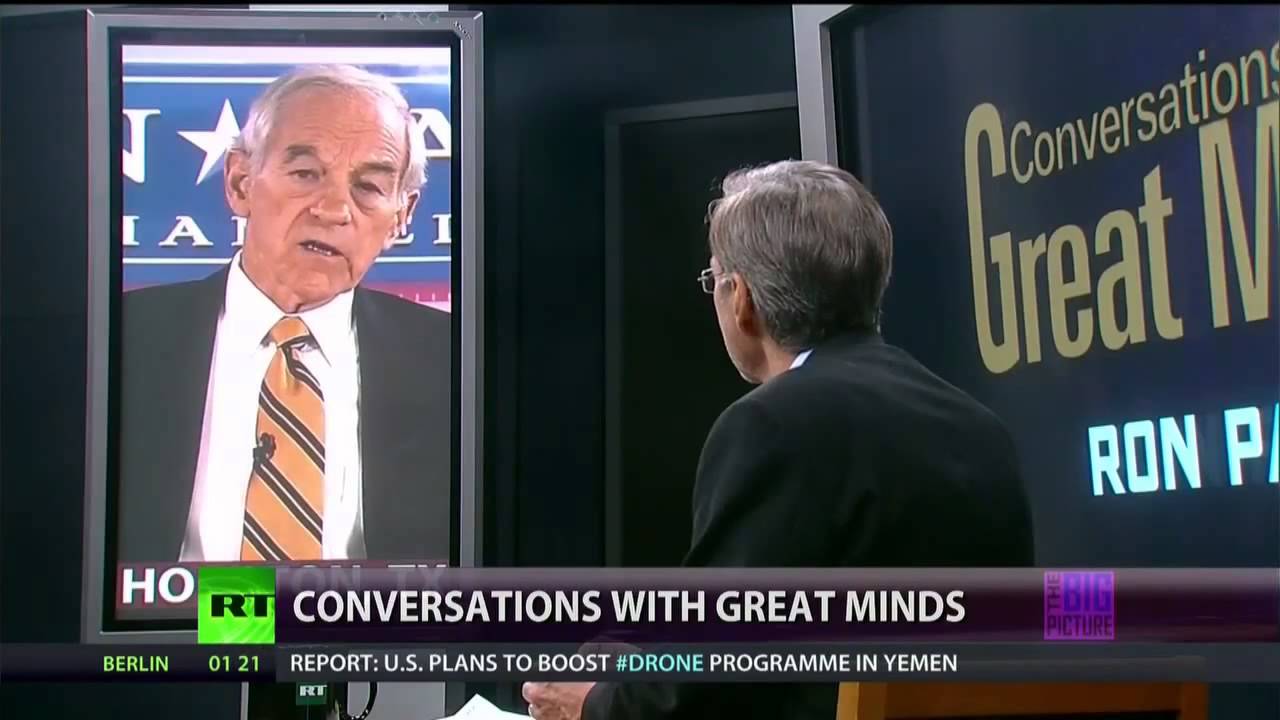
“Ron Paul is America’s leading voice for limited, constitutional government, low taxes, free markets, sound money, and a pro-America foreign policy.”
Tag Archives: Welfare-Warfare State
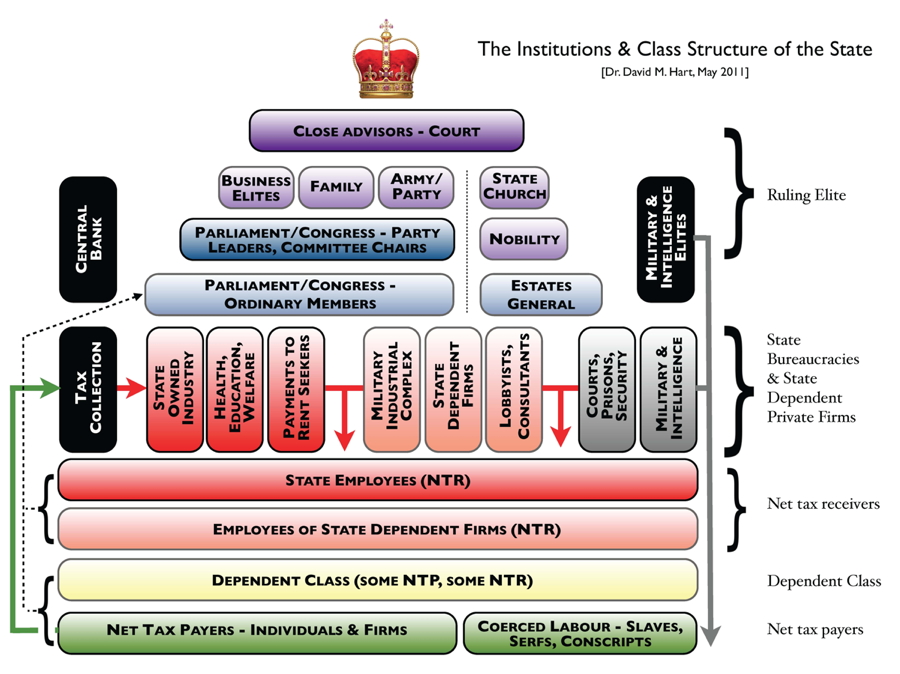
The Top of the Pyramid
The Triumvirate of Modern Warfare
“In both Great Britain and the United States, the basis for mass warfare came just before World War I. The income tax, when coupled with central banking, and followed by the abolition of gold coin redeemability of the banking system, all combined to create the worst war in man’s history, World War I. It was followed by World War II. Then came the Cold War, with its massive military expenditures by the USA. There has been an unbreakable relationship over the past century that combined the graduated income tax, central banking, the abolition of the gold standard, and the rise of empire.”
http://teapartyeconomist.com/2013/04/15/the-triumvirate-of-modern-warfare/
How to End the Wars – It really is easy and it’s been done before
![]()
“The slaughter of millions of southeast Asians and a rising US military death toll was angering the people. LBJ’s war was such a disaster that his re-election was in jeopardy. As the situation grew progressively worse for LBJ, he feared the humiliation of a general election or primary defeat so he decided NOT to run for re-election in 1968. Nixon, a foreign policy hawk, won the 1968 election. The Vietnam War resulted in over 58,000 dead Americans but the hawks were determined to wage the Vietnam War for all eternity. However, Nixon was soon smothered with anti-war Congress Critters who ferociously fought to end the Vietnam War. By 1973, Congress simply refused to fund it.”
http://judymorrisreport.blogspot.com/2013/05/how-to-end-wars-it-really-is-easy-and.html
Our Moral Crisis
“It seems official, the United States is a permanent wartime state. Senior Obama Administration officials have stated that the War on Terror, in its ‘limitless form,’ will carry on for another decade, possibly two. Given our role in the world, as an economic and military super-power, and given the economic, social and environmental crisis we see the world in, we must no longer deny that US foreign policy is a great agent of repression. We are a global threat to peace, security, liberty and the environment. Violence has become our foreign policy – it is the status quo. Perhaps what is most disturbing is the support the public lauds on politicians who support aggressive foreign policy.”
Baby Boomers Put Retirement on the Back Burner

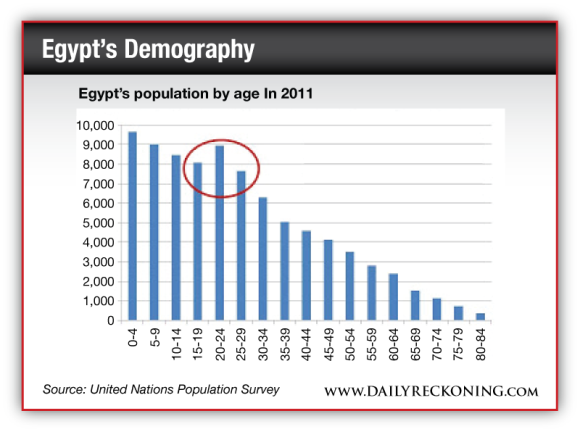
“Demographics continue to define conflict in the Middle East. Here’s Egypt’s population by age group. In Western history, we showed in Financial Reckoning Day, the French and Russian revolutions also corresponded with epochs during which large cohorts of young people marauded about the countryside with nothing to do. Even here in the U.S., a restless band of baby boomers wreaked havoc in the 1960s… at least until the draft was abolished. If, as Auguste Comte suggested, ‘demography is destiny,’ we continue to wonder today what will happen to the West when hordes of those baby boomers, now old, have nothing to do… and no savings?”
http://dailyreckoning.com/baby-boomers-put-retirement-on-the-back-burner/
The Real Reason College Costs So Much

“In 1964, federal student aid was a mere $231 million. By 1981, the feds were spending $7 billion on loans alone, an amount that doubled during the 1980s and nearly tripled in each of the following two decades, and is about $105 billion today. Taxpayers now stand behind nearly $1 trillion in student loans. Meanwhile, grants have increased to $49 billion from $6.4 billion in 1981. By expanding eligibility and boosting the maximum Pell Grant by $500 to $5,350, the 2009 stimulus bill accelerated higher ed’s evolution into a middle-class entitlement. Fewer than 2% of Pell Grant recipients came from families making between $60,000 and $80,000 a year in 2007. Now roughly 18% do.”
http://online.wsj.com/article/SB10001424127887324619504579029282438522674.html
Food Stamp Nation
“The USDA has acknowledged a formal partnership with the Mexican government to boost food stamp enrollment among Mexican nationals. In fact, in response to oversight inquiries from Republicans in Congress, the USDA revealed that the current administration has met with Mexican officials approximately 30 times as part of the partnership. The USDA has also adopted a range of strategies and programs designed to enroll more people in food stamps by overcoming the notion of self-reliance. A 2011 USDA Hunger Champions Award document reveals that local assistance offices have been rewarded for ‘counteracting’ pride when pushing more people to sign up for benefits.”
Obama offers plan to deal with the high cost of college

“Barack Obama took aim at the spiralling cost of higher education on Thursday, threatening US universities with a new official ranking system he claimed would help students identify whether they were getting value for money. As crippling student loans are increasingly seen as a impediment to social mobility and a check on US consumer confidence, the president used the latest of his economic speeches to propose a series of limited reforms to encourage lower fees. Besides the new ratings system, Obama’s proposals amounted to a call on state legislatures to stop cutting subsidies, universities to stop putting up fees, and Congress to pass laws limiting loan repayments.”
http://www.rawstory.com/rs/2013/08/22/obama-offers-plan-to-deal-with-the-high-cost-of-college/
Debt Excess and the Liquidation Process in a Historical Context

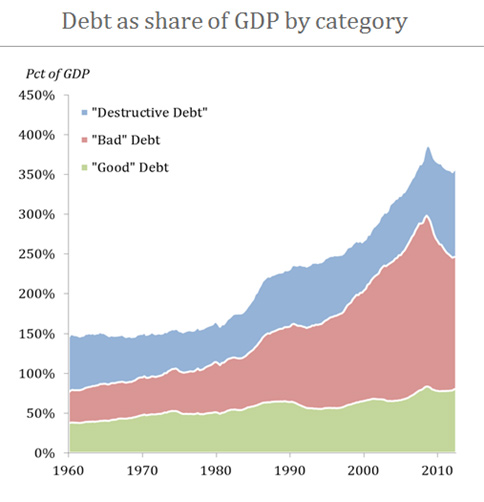
“We find it constructive to divide debt into three categories based on the criteria of capital consumption. We’ll start with liabilities taken on with the intent of making a subsequent sale at a profit: in other words, debt that increases the capital base, such as business loans. We call this ‘good’ debt. In the second category, we have mortgages, financial sector loans and foreign debt, all of which are classified as ‘bad’ debt. In the third and last category, we have debt that allows pure capital consumption, such as consumer credit and government debt. It should be obvious that consumptive debt cannot exceed productive debt for an indefinite period of time.”